
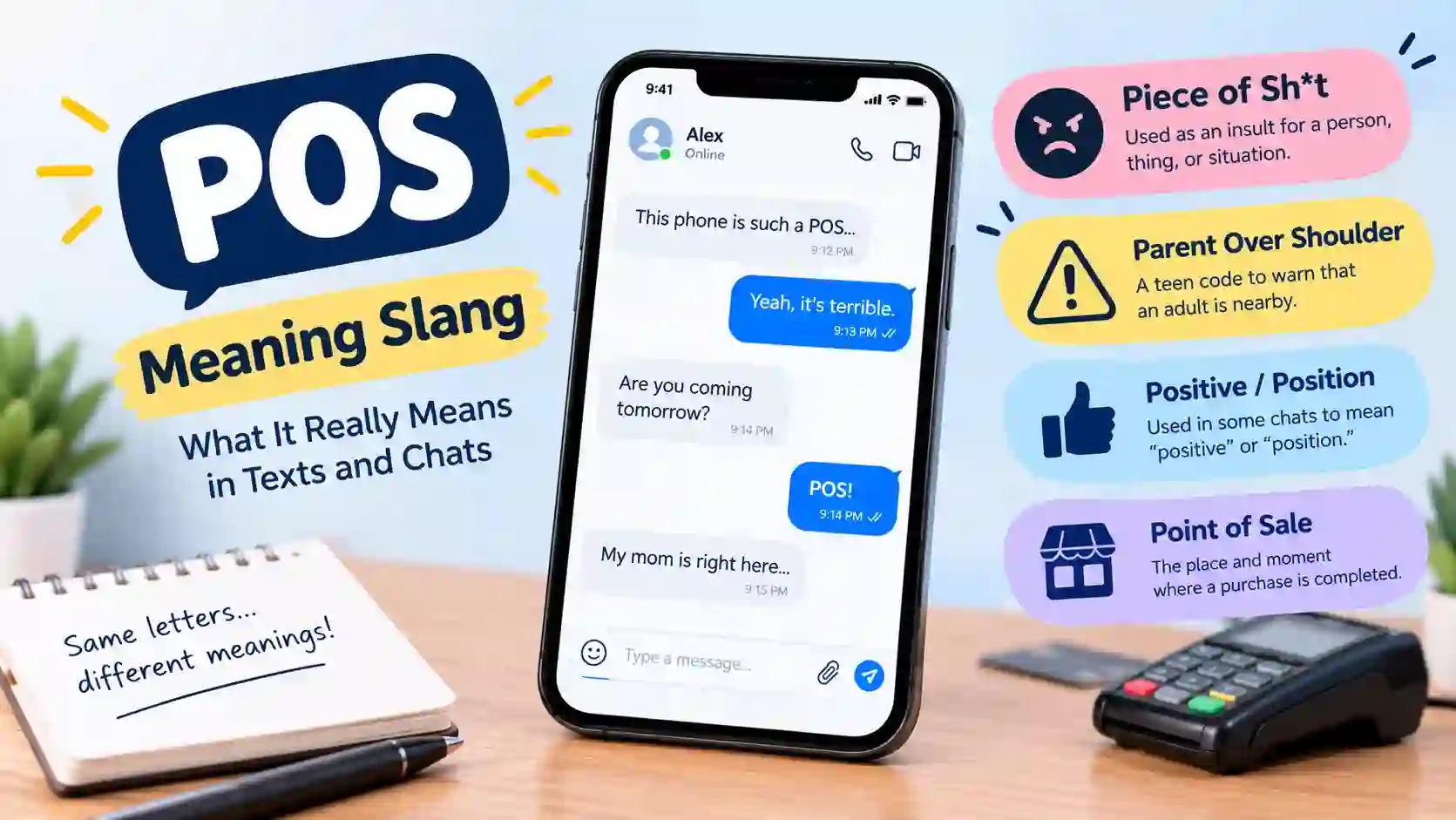
A lone “POS” on a phone screen can cause real confusion. The pos meaning slang shifts with the sender, the tone, and the app. Some readers see a harsh insult. Others think it is a secret code. A wrong guess can spark a fight, or hide a real warning sign from a worried parent.
The good news is that the answer is simple once context is clear. Short posts, comments on TikTok stories, and group chats all use the term daily. This guide explains each meaning, shows real examples, and gives safe ways to reply. By the end, readers will decode POS in seconds.
What Does POS Mean in Slang?
In everyday slang, POS most often stands for “Piece of Sh*t.” It is an internet initialism for something terrible, useless, or frustrating. People use it for broken gadgets, bad apps, and rude behavior. According to Fossbytes, the term also works as a label for a person who acts badly.
The word is vulgar, but it is also short and fast to type. That is why it spreads so well in texts, comments, and gaming chats. It lets a writer vent in three letters. Still, the same letters can carry other meanings, so readers should always check the surrounding message first.
POS as “Piece of Sh*t”
This is the meaning that most people mean when they ask about slang. It works as a noun or an adjective. A writer might say “this POS phone keeps freezing.” Here, the term describes an object that fails. The anger is aimed at the thing, not at a person.
POS Aimed at a Person
When the target is a person, the tone turns sharp. A message like “he is such a POS” shows deep anger or disgust. Experts at MMGuardian describe it as derogatory but generally harmless in teen chats. Even so, it can hurt feelings and escalate online arguments quickly.
Why the Abbreviation Feels Milder
An abbreviation feels softer than the full phrase. Many users type POS to skip the swear word. That choice can make a rude message seem casual. However, the reader still understands the insult. Therefore, the shortcut does not remove the harm. It only hides the full words from view.
Other Meanings of POS in Texting
Slang rarely stays in one lane. Besides the insult, POS has other uses in texts, games, and chats. Most of them are harmless. A few exist only to warn friends about a nearby adult. Knowing each one helps readers avoid an embarrassing mistake, such as replying with an insult to a casual note.
Context is the key to every case. A teen typing in a quiet room means something different from a gamer typing during a match. Likewise, a shop owner discussing a payment system uses the term in a business sense. Readers should look at who wrote it, when, and why.
Parent Over Shoulder
Parent Over Shoulder is a teen texting code. A sender types POS to tell a friend that an adult is close. The friend then knows to pause or change the topic. Fossbytes lists this as a common alternate meaning, and MMGuardian notes that teens sometimes use it exactly this way.
POS as Positive or Position
Some chats use POS as short for “positive.” A test result, for example, may be marked POS in casual notes. Gamers and sports fans also shorten “position” to POS. A player might ask a teammate for their pos on the map. These uses are neutral and carry no insult.
How People Use POS in Real Conversations
Real examples make the term much easier to spot. Most messages fall into three groups: complaints about things, anger at people, and warnings to friends. Each group has its own clues. Readers who learn these clues can decode almost any message without asking the sender for help.
The pos meaning slang also depends on the platform. On Snapchat and Instagram, short replies are common, so POS may stand alone. In long group chats, it often appears inside a longer sentence. Because of this, the length and style of the message are useful hints for any reader.
Examples With Objects and Services
People often call faulty items POS. “This POS laptop died again” is a classic case. A slow website can get the same label. In these sentences, the writer is annoyed at quality, not at another human. The sentence usually includes a gadget, an app, or a service.
Examples With People
People-based examples are harsher. “You are a POS” is a direct insult. “He lied to me, what a POS” expresses betrayal. These messages deserve more attention, especially between teens. Repeated use against one person can point to bullying, so adults should watch the pattern rather than the single word.
Examples as a Warning Code
The warning is easy to spot. It appears alone, often in the middle of a chat. There is no object and no person being insulted. The next messages usually change topic or stop. That sudden shift is the best clue that POS means a parent is nearby.
How to Handle POS Messages Safely
For most readers, the safest move is to pause and read the full chat. Jumping to anger or panic rarely helps. A calm look at the words around POS usually reveals the meaning. This habit works for parents, teachers, and friends alike, and it saves a lot of needless conflict.
Parents should also remember that slang changes quickly. Today’s code may look different next year. Open talks work better than strict rules. When teens feel heard, they share more about their online lives. That trust protects them far better than any filter can.
Tips for Parents
Parents can start with a simple question. They might ask what the word means to their teen. MMGuardian suggests asking how a teen would feel if someone called them that online. This approach builds empathy. It also shows that the parent wants to understand, not to punish.
Tips for Replying as a Friend
A friend who gets a lone POS should stay calm. A quick “all good?” works in most cases. If the term was a warning, the friend can switch topics. If it was an insult, the friend can ask what happened. Kind replies keep chats friendly and safe.
When to Take It More Seriously
One rude word is rarely an emergency. However, a steady stream of insults can signal harassment. Look for threats, secrecy, or sudden mood changes. In those cases, a calm talk is the right first step. Schools and trusted adults can then help if the problem continues.
Point of Sale: The Business Meaning of POS
Outside slang, Point of Sale is the best-known meaning of POS. It means the time and place where a retail sale is completed, as Wikipedia explains. This could be a cash register, a card reader, or an online checkout. Shoppers meet it every time they pay.
This meaning is fully professional and has nothing to do with insults. A café owner might say, “We installed a new POS to speed up payments.” Mixing up the two meanings is the most common error. A quick look at the topic, such as shops and payments, solves the puzzle right away.
What a POS System Does
A modern POS system combines hardware and software. It records sales, takes payments, and updates stock levels. Many also track customers and print receipts. Because of these features, small shops and large chains both rely on them every day to run smoothly.
Where the Term Came From
The idea is not new. Wikipedia notes that IBM released its 3650 and 3660 store systems in August 1973. These machines controlled many registers from one central computer. That early step shaped the modern checkout, and the term POS has stayed in business language ever since.
How Businesses Connect Sales and Support
Today’s stores do not stop at the checkout. Many firms link sales records with their help desks, so staff can solve refund and order issues faster. Teams often pair a POS with contact center software to keep customer talks organized in one place.
Frequently Asked Questions
What does POS mean in slang?
In slang, POS usually means “Piece of Sh*t.” It describes a person or thing that is terrible or frustrating. It can also mean “Parent Over Shoulder” in teen chats. The meaning depends on the message and the sender.
What does POS mean in a text message?
In a text, it is either an insult or a warning. An insult usually names a person or a broken item. A warning appears alone and tells friends an adult is nearby. Reading the full chat clears up the doubt.
Is POS a bad word?
The full phrase is vulgar, so the abbreviation is rude too. Many people treat it as a mild insult because it is short. Still, it can hurt when aimed at someone. It does not belong in school, work, or formal writing.
What does POS mean on Snapchat or Instagram?
On these apps, it usually follows the same two slang meanings. Teens may send it as an insult in comments. They may also send it as a quick alert about a parent. Platform does not change the core meaning.
What does POS mean when a teen sends it?
A teen may mean “Parent Over Shoulder,” which is a harmless pause signal. They may also mean the insult during a heated chat. Parents should read the surrounding messages before reacting. A calm question usually gives the clearest answer.
Does POS mean something else besides slang?
Yes, the best-known other meaning is Point of Sale. It is the place and moment where a purchase is completed. POS can also be short for “positive” or “position” in casual use. These meanings are neutral.
How can someone tell which meaning is used?
Look at the topic and the sender. Shops and payments point to Point of Sale. Anger at a person or gadget points to the insult. A sudden stop in the chat points to the parent warning. Context solves most cases.
Should parents worry about the term POS?
Usually not. The word is mostly harmless slang. However, repeated use against one person may signal bullying. Parents should talk openly and stay calm. Strong trust at home matters more than monitoring a single abbreviation.
Final Thoughts on POS Meaning Slang
The pos meaning slang is simple once the clues are clear. Most of the time, POS is a rude shortcut for “Piece of Sh*t.” In teen chats, it can also warn that a parent is close. In business, it means Point of Sale. Context always decides which one fits best.
Readers who want to keep up with fast-changing online language should keep exploring. Visit futuretechguide.it.com for more clear, trusted guides on slang, apps, and everyday tech. Share this article with a parent, teacher, or friend who still wonders what those three letters mean.