
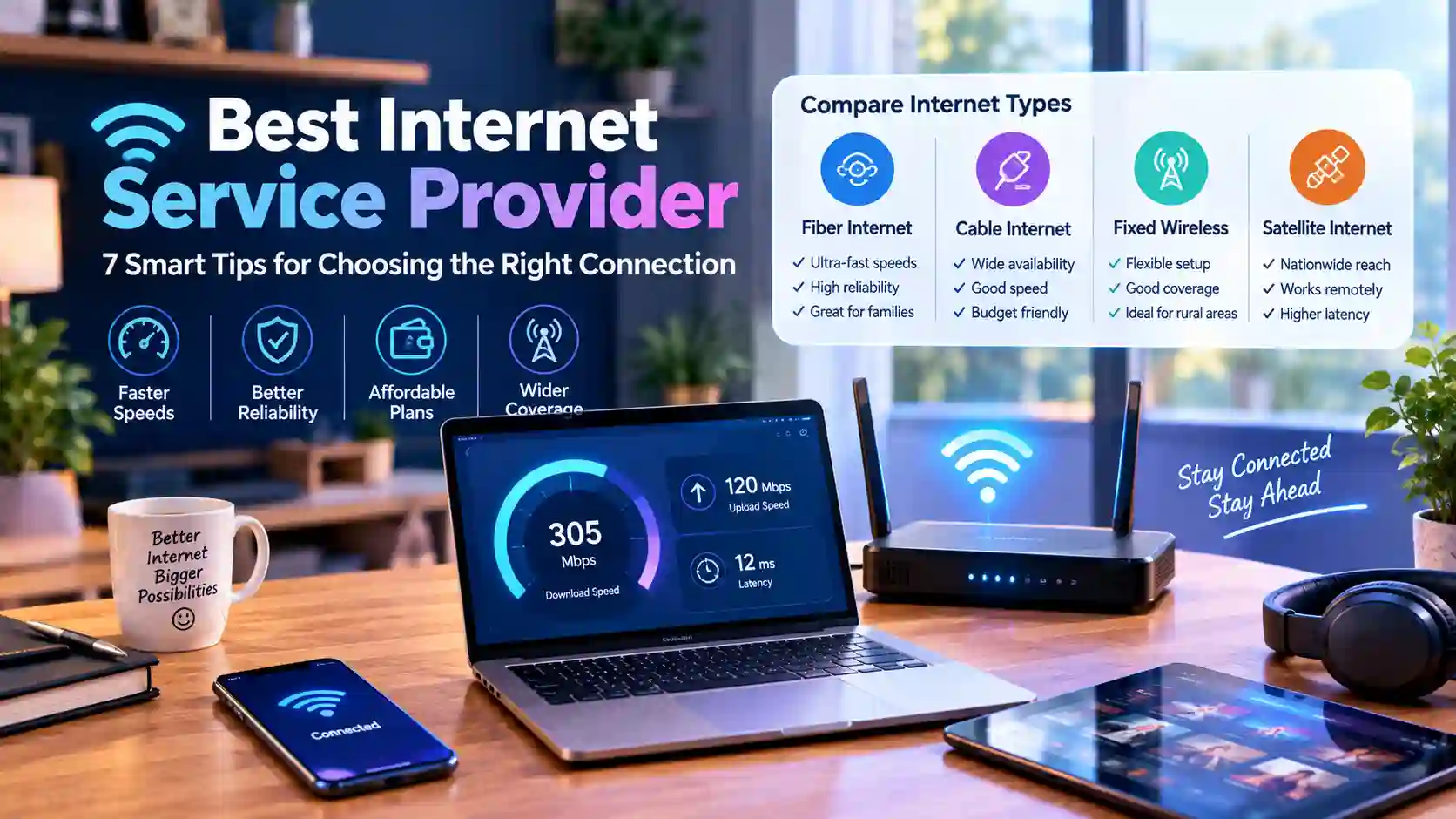
Choosing the best internet service provider can feel difficult when every company promises fast speeds and reliable service. However, internet plans can differ greatly in speed, technology, pricing, coverage, and contract terms. A plan that works well for one household may not suit another. Therefore, comparing the important details can prevent expensive mistakes and frustrating connection problems.
Slow internet can affect streaming, gaming, remote work, video calls, and everyday browsing. Moreover, paying for high speeds does not always guarantee a better online experience. The right choice depends on location, household size, connected devices, usage habits, and service quality. A careful comparison helps households choose a connection that matches real needs.
What Makes the Best Internet Service Provider?
The best internet service provider should offer a useful balance of speed, reliability, coverage, support, and price. No single company is automatically ideal for every customer. Local availability also plays a major role because providers and technologies vary between cities and neighborhoods.
Therefore, customers should compare several factors before selecting a plan. Download speed matters, but upload performance, network stability, data limits, equipment fees, and contract rules also deserve attention. A balanced plan often provides more value than the plan with the biggest advertised speed.
Reliable Internet Service
Reliability is one of the most important parts of a good internet connection. A fast connection becomes less useful when it drops during work meetings or online activities. Frequent outages can also make a low-cost plan frustrating over time.
Therefore, households should consider the provider’s service reputation in their local area. Reviews from nearby customers can offer useful practical information. However, individual experiences can differ, so several sources should be compared before making a decision.
Consistent Connection Speeds
Advertised internet speeds do not always represent the experience at every moment. Network congestion, Wi-Fi equipment, device limitations, and home layout can affect performance. Wired connections can also behave differently from wireless connections.
A suitable plan should provide enough capacity for normal household activity. For example, a family with several active devices may need more capacity than a single light internet user. Matching the plan to actual usage can prevent unnecessary spending.
Helpful Customer Support
Customer support becomes important when an outage or technical problem occurs. A provider should offer clear ways to report problems and receive assistance. Phone support, online chat, service alerts, and troubleshooting resources can all improve the customer experience.
However, support quality can vary between locations and service types. Therefore, local reviews can help reveal how quickly problems are usually handled. A slightly cheaper plan may become less attractive if technical support is consistently difficult to reach.
How Internet Connection Types Compare
Internet providers use different technologies to deliver service. The main options include fiber, cable, DSL, fixed wireless, satellite, and some newer wireless solutions. Each technology has different strengths and limitations.
Therefore, understanding the connection type is essential before choosing an internet plan. A plan with a high advertised speed may still behave differently depending on the underlying technology. Local infrastructure also determines which options are available.
Fiber Internet
Fiber internet uses optical fiber to transmit data. It can provide high speeds and strong performance for demanding online activities. Fiber connections are often attractive for homes with heavy streaming, gaming, cloud usage, and multiple active devices.
Fiber can also provide strong upload performance. This feature matters for video calls, cloud backups, content uploads, and other tasks that send large amounts of data. However, fiber availability depends heavily on local infrastructure.
Cable Internet
Cable internet uses infrastructure originally developed for television services. It can provide strong download speeds and broad availability in many areas. Cable plans can therefore work well for families with common home internet needs.
However, performance can vary with local network conditions. Upload speeds may also differ from those offered by fiber plans. Customers should review both download and upload specifications before selecting a cable connection.
DSL, Fixed Wireless, and Satellite
DSL uses telephone infrastructure to provide internet service. It can remain useful in areas where newer networks are unavailable. However, performance can depend on infrastructure and distance from network equipment.
Fixed wireless uses radio signals from a nearby network point. Satellite internet can serve locations where wired infrastructure is difficult to install. These options can expand coverage, although latency, weather, network capacity, and equipment requirements may differ.
How Much Internet Speed Does a Household Need?
The required internet speed depends on how many people use the connection and what they do online. A household that mainly browses websites needs less capacity than a home with several simultaneous video streams and online gaming sessions.
Therefore, customers should avoid choosing a plan based only on the largest speed number. The best internet service provider is the one that offers enough performance for the household’s actual needs. Extra speed can be useful, but excessive capacity may add cost without providing meaningful benefits.
Internet for Light Browsing
Light users usually spend time browsing websites, checking email, reading articles, and using social media. These activities generally do not require the highest available speed tiers.
However, multiple devices can increase total demand. Smartphones, laptops, smart speakers, televisions, and other connected devices can all use bandwidth. A basic plan may work well for smaller households with limited simultaneous activity.
Internet for Streaming and Families
Streaming services can create greater demand, especially when several household members watch content simultaneously. Video quality also affects bandwidth requirements. Higher-quality streams generally require more data than lower-quality streams. Households with several connected devices can also explore cool tech gadgets for 2026 when improving their overall home technology setup.
Families should therefore consider the number of simultaneous users. A household with several active screens may benefit from a faster plan. Still, network reliability and Wi-Fi coverage remain important factors beyond the advertised speed.
Internet for Gaming and Remote Work
Online gaming depends on more than download speed. Latency, connection stability, and packet handling can strongly affect the experience. Lower latency can make online interactions feel more responsive.
Remote workers also need stable connections for video meetings, file transfers, and cloud applications. Upload performance becomes especially important when sending large files or using cloud-based work tools. Therefore, gamers and remote workers should examine more than download speed.
How to Compare Internet Provider Prices
Price comparison should include the full monthly cost rather than only the introductory rate. Providers may offer promotional pricing for a limited period. After that period, the regular monthly charge may increase.
Customers should also examine equipment charges, installation fees, taxes, data fees, and other possible costs. Comparing the complete cost provides a clearer picture of long-term value. A low introductory price does not always mean a cheaper plan overall.
Promotional Pricing
Promotional rates can make an internet plan look highly affordable at first. However, the customer should check how long the promotional period lasts. The regular price after the promotion can significantly change the overall cost.
Therefore, pricing information should be reviewed before signing an agreement. Customers should record both the initial price and expected standard rate. This simple step can make provider comparisons much clearer.
Equipment and Installation Fees
Some providers include a modem or router with certain plans. Others may charge monthly equipment fees. Installation can also create a separate one-time cost.
Customers should therefore ask for the complete cost before ordering service. Equipment ownership rules can also matter when canceling service. Clear pricing reduces surprises on the first few bills.
Contracts and Cancellation Terms
Some internet plans require contracts, while others provide month-to-month service. Contract plans may include early termination charges. Month-to-month plans can provide more flexibility but may have different pricing.
The contract terms should be read before the service begins. Customers should understand cancellation rules, equipment returns, promotional periods, and price changes. These details can affect the real value of a plan.
How to Check Internet Availability
Availability is one of the first factors customers should verify. Internet companies may serve one neighborhood while having limited coverage in another nearby area. Even the same provider can offer different technologies across a city.
Therefore, a provider’s website should be checked using the exact service address. Customers should confirm the connection type and available plans before making a final choice. General coverage maps can provide useful information, but address-level checking is more precise.
Address-Level Availability
A service address can determine which internet technologies are offered. One building may have fiber access while another nearby property only has cable or wireless service.
Therefore, customers should not rely only on advertisements or general city coverage. Exact address checks provide more useful information. Availability should be confirmed before comparing final plan prices.
Local Network Infrastructure
Infrastructure plays a major role in internet performance. Fiber networks, cable systems, wireless towers, and other infrastructure differ between locations.
A provider with an excellent reputation in one city may offer a different experience elsewhere. Local infrastructure and network capacity can influence reliability. This is why neighborhood-level research can be valuable.
Rural and Remote Areas
Rural households may have fewer internet choices than urban customers. Fiber and cable networks may not reach every remote location. Fixed wireless and satellite services can provide alternatives.
However, customers should compare latency, data policies, equipment requirements, and expected performance. The right option depends heavily on location and household usage. Availability should always be confirmed directly with the provider.
How to Test Internet Performance
After installation, customers can test the connection to determine whether it performs as expected. Speed tests can provide information about download speed, upload speed, and latency.
However, a single test does not tell the complete story. Testing at different times and from different devices can provide a clearer picture. Wired testing can also help separate internet performance from Wi-Fi problems.
Test Download and Upload Speeds
Download speed affects activities such as streaming and downloading files. Upload speed matters when sending files, backing up data, or using video conferencing.
Therefore, both measurements should be considered. A plan with excellent download performance may still feel limiting for users who regularly upload large files.
Check Latency and Stability
Latency measures how long data takes to travel between systems. Lower latency can improve interactive activities such as gaming and video calls.
Connection stability also matters. Frequent interruptions can create problems even when speed tests show strong results. Customers should watch for repeated drops or unusual fluctuations.
Test Wi-Fi Separately
A slow Wi-Fi connection does not always mean the internet provider is responsible. Router placement, interference, device limitations, and home construction can affect wireless performance.
Customers can test the connection near the router and farther away. Comparing wired and wireless results can also help identify the source of a problem. This process can prevent unnecessary provider changes.
How to Choose the Best Internet Service Provider for Different Needs
The ideal provider depends on the customer’s priorities. Some households need maximum speed, while others prioritize affordability or flexible contracts. Therefore, the best internet service provider can differ between customers.
A practical comparison starts with the main use case. The household can then compare available technologies, speeds, pricing, support, and terms. This approach keeps the decision focused and avoids unnecessary features.
Best Choice for Families
Families often have many connected devices operating at the same time. Smartphones, televisions, laptops, gaming systems, and smart-home devices can all compete for network capacity.
A family plan should therefore provide enough speed and stable Wi-Fi coverage. Multiple users can benefit from a connection that handles simultaneous activity without major slowdowns. However, paying for extreme speeds may not be necessary for every family.
Best Choice for Gamers
Gamers should focus on latency, stability, and consistent performance. Download speed still matters, especially for large game updates. However, extremely high download speeds cannot automatically fix high latency.
A wired Ethernet connection can also improve stability for gaming devices. Therefore, the internet plan and home network should be considered together. The provider is only one part of the complete gaming setup.
Best Choice for Remote Workers
Remote workers often depend on stable video calls and cloud services. Upload performance can become important when large files are shared or backed up. A reliable laptop also supports smooth remote work, especially for users comparing laptops such as the Clevo PA71 for demanding tasks.
A reliable connection can also reduce disruptions during meetings. Remote workers should therefore consider uptime, support, upload speed, and router performance. These factors may matter more than the highest advertised download number.
Questions to Ask Before Choosing an Internet Provider
A few simple questions can reveal important differences between providers. Customers should understand the plan before agreeing to service. Clear answers can prevent unexpected costs later.
The following questions can help create a useful comparison:
- What connection type is available at the exact address?
- What are the normal download and upload speeds?
- Does the plan have a data limit?
- What is the regular price after promotional pricing?
- Are equipment or installation fees included?
- Does the plan require a contract?
- What happens when the service is canceled?
- How does the provider handle outages and technical support?
Understanding Data Limits
Some internet plans may include specific data policies. Customers should check whether the plan has a monthly allowance or other usage conditions.
Heavy streaming, cloud backups, and large downloads can increase monthly data use. Therefore, households with high usage should understand the provider’s data terms before choosing a plan.
Understanding Network Management
Some providers may have network management policies that affect how traffic is handled. Customers should review the provider’s service terms for detailed information.
This can matter for households with heavy usage or specialized requirements. Clear policies help customers understand how the connection may perform during busy periods.
Understanding Customer Reviews
Customer reviews can reveal practical issues that advertisements may not mention. However, individual reviews should not be treated as complete evidence.
Several recent reviews from the same local area can provide more useful context. Customers should look for repeated patterns involving outages, billing, installation, or support. Balanced research is more useful than relying on one extreme review.
Internet Security and Home Network Protection
Choosing an internet provider is only one part of maintaining a safe connection. Home network security also depends on the router, passwords, connected devices, and software.
Customers should keep router firmware updated when updates are available. Strong Wi-Fi passwords can also reduce unauthorized access. Connected devices should receive security updates as well.
Secure the Wi-Fi Network
A strong wireless password helps prevent unauthorized users from joining the network. The router’s default administrator credentials should also be changed when appropriate.
Customers should avoid sharing the primary Wi-Fi password widely. A guest network can provide an additional option for visitors and less-trusted devices.
Update Router Software
Routers use software that can receive security updates. Installing available updates can help address known security issues.
Customers should check the router manufacturer’s guidance for update instructions. Provider-supplied equipment may also receive updates automatically, depending on the service.
Protect Connected Devices
Smart televisions, cameras, speakers, computers, and other devices can connect to the home network. Each device can create additional security considerations.
Strong passwords and regular software updates can reduce common risks. Unused devices should also be disconnected when they are no longer needed.
Frequently Asked Questions
What is the best internet service provider for a home?
The best internet service provider depends on local availability, connection type, speed needs, reliability, pricing, and support. Customers should compare plans available at their exact address before choosing.
Is fiber internet better than cable internet?
Fiber can provide excellent speed and strong upload performance. Cable can also provide fast service and may be more widely available in some areas. The better option depends on local availability, pricing, and household needs.
How much internet speed does a family need?
Speed requirements depend on the number of users and their online activities. Several simultaneous streams, gaming sessions, and work devices can require more capacity than basic browsing.
Does higher internet speed always mean better service?
Higher speed does not automatically mean better service. Reliability, latency, upload performance, Wi-Fi quality, and network stability also matter. A balanced plan can provide better practical value than an expensive high-speed tier.
What should customers check before choosing an internet plan?
Customers should check availability, connection technology, download and upload speeds, pricing, data policies, equipment fees, contracts, and customer support. These details provide a clearer picture of the complete service.
Is satellite internet useful in rural areas?
Satellite internet can provide service where wired infrastructure is limited. However, customers should consider latency, data policies, equipment requirements, and local alternatives before choosing it.
How can internet speed be tested at home?
A speed test can measure download speed, upload speed, and latency. Testing at different times and using both wired and wireless connections can provide more useful results.
Can Wi-Fi make a fast internet plan feel slow?
Yes, Wi-Fi conditions can affect the experience. Router placement, interference, distance, device limitations, and building materials can reduce wireless performance. Testing with Ethernet can help identify whether Wi-Fi is the main issue.
Conclusion:
Finding the best internet service provider requires more than choosing the plan with the largest speed number. A strong decision considers availability, connection technology, reliability, upload speed, latency, pricing, equipment, contracts, and customer support. These factors can differ significantly between locations and households.
The right choice should match the household’s real online activities and budget. Customers can compare local plans, confirm exact availability, review full pricing, and test network performance after installation. By following these steps, households can choose an internet connection that provides useful performance without paying for features they do not need.
5 thoughts on “Best Internet Service Provider: How to Choose the Right Connection”