
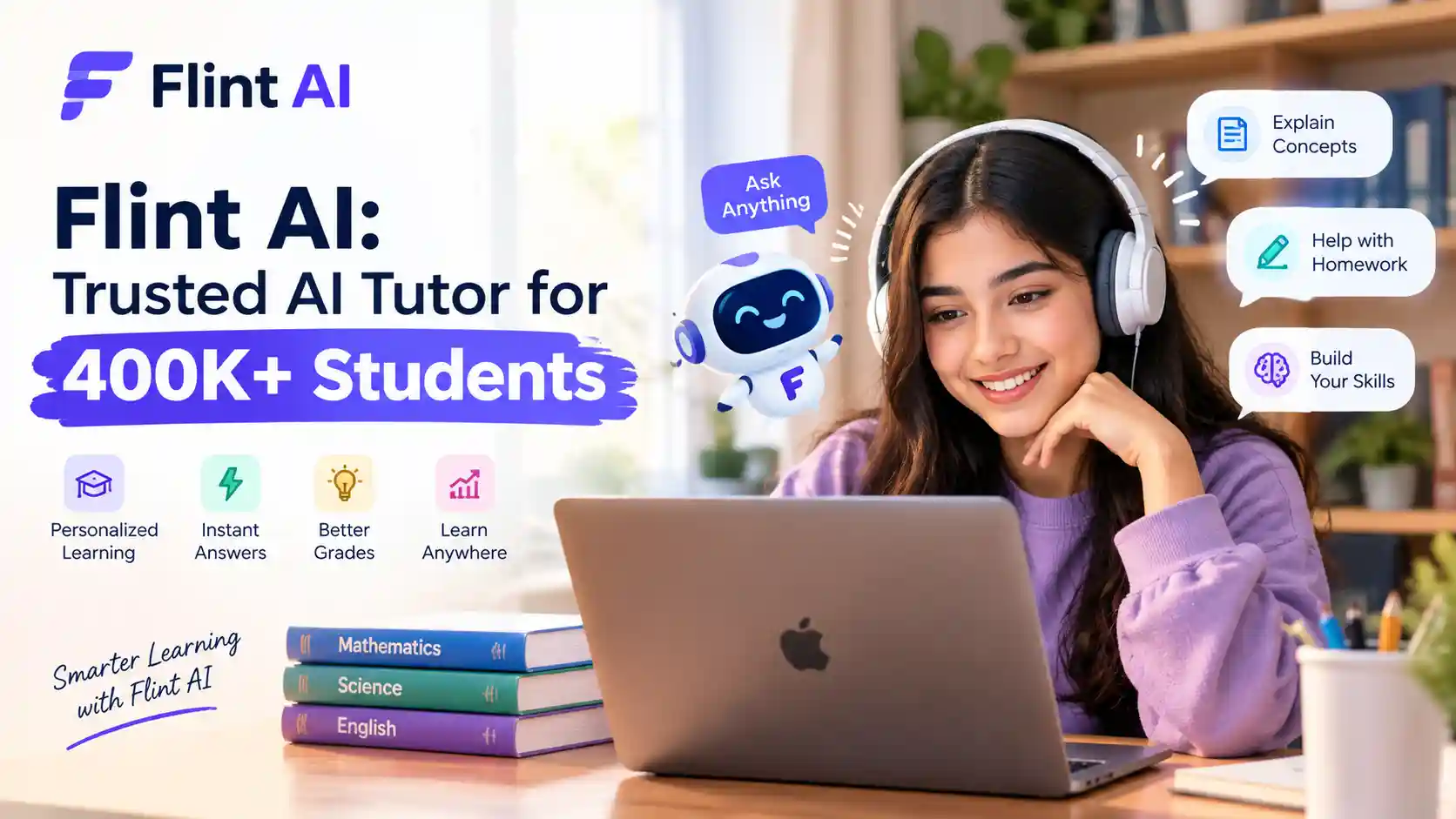
Many teachers feel stretched too thin every single day. Grading piles up, lesson plans need updates, and every student learns at a different pace. It becomes hard to give each child the one-on-one attention they truly deserve, and that gap often leaves both slower and advanced learners behind. This is exactly where Flint AI steps in to change the picture for schools everywhere.
Flint AI is an artificial intelligence platform built specifically for K-12 classrooms, and it aims to fix this exact problem. It gives teachers time-saving tools while offering students a patient, always-available tutor. Instead of forcing one-size-fits-all lessons, Flint AI helps every student learn at their own speed, in their own way, without adding extra hours to a teacher’s workload.
What Is Flint AI and Why It Matters Today
Flint AI is a platform designed to bring safe, structured artificial intelligence into everyday classroom learning. It was founded by Sohan Choudhury and Jinseo Park, and it grew out of Y Combinator’s Summer 2023 batch before expanding quickly across independent schools in the United States. The core idea behind Flint AI is simple: students need personal guidance, and teachers need their time back.
Today, Flint AI supports hundreds of thousands of teachers and students across the country and beyond. It focuses heavily on K-12 education, though colleges and independent school networks have also adopted the platform. Rather than replacing teachers, Flint AI works alongside them, handling repetitive tasks so educators can focus on real teaching moments.
The Problem Flint AI Was Built to Solve
Traditional classrooms often struggle to serve every student equally. A teacher managing thirty children simply cannot give each one individual feedback every day. Some students fall behind quietly, while others get bored waiting for the rest of the class to catch up. Flint AI was created to close this gap by giving every student a personal AI tutor that adjusts to their exact skill level.
This approach means struggling students get extra explanation without feeling singled out. Meanwhile, advanced students can move faster and explore topics deeper. Teachers still guide the overall lesson, but Flint AI fills the space where individual attention used to be impossible to deliver consistently.
How Flint AI Fits Into Modern Classrooms
Modern classrooms increasingly rely on digital tools and gadgets, yet many of those tools were never built with safety or curriculum alignment in mind. Flint AI was designed from the ground up for schools, meaning it fits naturally into existing lesson structures. Teachers can build activities tied directly to what they are already teaching that week.
Because Flint AI integrates with learning management systems and student information systems, it does not require schools to overhaul their entire technology stack. Instead, it slots into daily routines quietly, supporting lessons in math, science, writing, and world languages without disrupting the flow of the school day.
Who Uses Flint AI Right Now
Flint AI has been adopted by hundreds of independent schools, along with a growing number of public school districts. According to Pulse2’s coverage of Flint’s Series A funding, the platform supports more than 400,000 users and has powered over 150,000 AI-created learning activities. Notable school partners include respected independent academies, and the company recently partnered with Cognita, one of the largest K-12 school networks in the world.
This wide adoption shows that Flint AI is not a passing trend. Schools trust it enough to build it into daily instruction, and the growing user base suggests educators see real, measurable value in the platform’s approach to personalized learning.
Key Features That Make Flint AI Stand Out
Many AI tools exist for education, but Flint AI separates itself through features built specifically for classroom safety and teacher control. It does not simply hand students a chatbot and walk away. Instead, it wraps AI tutoring inside guardrails that administrators and teachers fully manage.
These features work together to create a balanced system. Teachers get visibility, students get support, and school leaders get the safety assurances they need before approving any new technology for their buildings.
AI-Powered Tutoring for Students
The heart of Flint AI is its 24/7 AI tutor. Students can ask questions any time, whether they are stuck on homework at night or reviewing before a test. Unlike a search engine, the tutor does not simply hand over the answer. It guides students toward understanding, asking follow-up questions and offering hints along the way.
This method builds real problem-solving skills instead of encouraging shortcuts. Students learn to think through challenges step by step, which strengthens long-term retention. The tutor also adjusts its explanations based on how a student responds, making each session feel personal rather than generic.
Time-Saving Tools for Teachers
Teachers gain access to tools for lesson planning, grading support, and creating custom AI-driven activities. Instead of spending hours building differentiated worksheets, a teacher can design one activity that automatically adapts to each student’s level. Flint AI then handles the back-and-forth conversation with students while the teacher monitors progress.
This shift frees up hours every week that would otherwise go toward repetitive grading or lesson prep. Teachers can instead spend that time planning creative projects or offering direct support to students who need it most. Many educators describe this as the biggest practical benefit of adopting the platform.
Safety, Privacy, and Data Guardrails
Because Flint AI serves students under the age of thirteen, privacy and safety sit at the center of its design. The platform states it does not use student chat data to train its underlying AI models, and shared conversations stay visible only within a student’s own school network. Administrators can also review chat history when needed, adding another layer of oversight.
Flint AI is also built to align with FERPA and follow GDPR-style data protection principles, which matters greatly to school leaders evaluating new technology. These guardrails give parents and administrators confidence that students can explore AI tools without the same risks found in open, consumer-facing chatbots.
How Flint AI Works Behind the Scenes
Understanding how Flint AI actually functions helps schools decide if it fits their needs. The platform is not just a chatbot bolted onto a dashboard. It is a structured system built around three main stages: setup, activity creation, and ongoing tracking.
Each stage is designed to keep teachers in control while still giving Flint AI enough flexibility to personalize the experience for every student in the room.
Setting Up a Classroom on Flint AI
Getting started typically begins with an administrator provisioning access through email invites or Google Authentication. This step keeps the platform closed to outside users and ensures only verified students and staff can log in. Once accounts are active, teachers can create classes and invite students directly.
The onboarding process is designed to feel familiar to anyone who has used a learning management system before. Schools do not need extensive technical training to begin, and Flint AI offers professional development sessions to help staff feel comfortable from day one.
Creating Custom AI Activities
Teachers can build activities with specific objectives, methods, and content tied to their curriculum. For example, a teacher might create a conversational quiz that checks understanding of a recent science lesson. Flint AI then holds a one-on-one conversation with each student, adjusting difficulty based on their answers.
This flexibility means the same platform can support a math review, a language practice session, or a debate exercise. Because teachers design the activity structure, the content always stays aligned with what students are actually learning in class that week.
Tracking Progress With Real-Time Insights
While students work through an activity, Flint AI records how they respond, where they struggle, and how long tasks take. Teachers can view this data through a dashboard that highlights patterns across the whole class. This visibility helps identify which students need extra help before a test, rather than after grades come back.
Real-time insight also supports better lesson planning. If a teacher sees that most students misunderstood a concept, they can revisit it the next day instead of moving forward with gaps in understanding still present.
Benefits of Flint AI for Students and Teachers
The combined effect of these features creates real benefits for everyone involved in the classroom. Students feel more supported, teachers feel less overwhelmed, and schools gain a tool that scales personalized learning without hiring additional staff.
These benefits explain why adoption has grown so quickly since the platform’s launch, and why investors backed its recent funding round with confidence.
Personalized Support for Every Learner
Every student learns differently, and Flint AI adjusts to that reality instead of ignoring it. A student who needs extra repetition gets it without feeling embarrassed in front of classmates. A student ready to move faster is not held back waiting for others to catch up.
This kind of individualized pacing was once only possible through private tutoring, which many families cannot afford. Flint AI brings a similar experience into the regular school day, making personalized support available to a much wider group of students.
Reduced Workload for Educators
Teacher burnout remains a serious concern across schools nationwide, and repetitive administrative work is a major contributor. By handling grading support, activity creation, and one-on-one tutoring conversations, Flint AI reduces the daily burden placed on educators.
This does not mean teachers become less involved. Instead, they shift their energy toward high-value tasks like mentoring, creative lesson design, and addressing the emotional needs of their students, which no AI tool can replace.
Building AI Literacy Early
Flint AI also includes training modules that teach students and teachers the basics of how large language models work. This matters because students will graduate into a world where AI tools are common in nearly every industry. Understanding how these systems work, including their limitations, prepares students for responsible use later in life.
Rather than banning AI outright or ignoring it, schools using Flint AI take a proactive approach. They teach students how to use these tools thoughtfully, which builds stronger digital literacy than avoidance ever could.
Flint AI Growth, Funding, and Market Trust
Flint AI’s rapid growth offers a strong signal of trust from both schools and investors. Understanding this trajectory helps administrators judge whether the platform is a stable long-term choice rather than a short-lived trend.
Financial backing and school partnerships both matter when evaluating education technology, since schools need tools that will still be supported years from now.
Recent Funding and Expansion
In November 2025, Flint announced a $15 million Series A funding round, co-led by Basis Set Ventures and Patron. According to Pulse2, additional investors included USC Viterbi, AME Cloud Ventures, and education leaders such as Blackboard founder Matt Pittinsky. This funding is intended to accelerate product development and help Flint scale to millions of students over the following year.
This level of investment shows that experienced education and technology investors see long-term potential in Flint AI’s approach. It also gives the company resources to continue improving safety features and expanding into new subjects and grade levels.
Schools and Partners Using Flint AI
Flint AI has built partnerships with well-regarded independent schools, including The Episcopal Academy, Springside Chestnut Hill Academy, and Sewickley Academy. The platform also recently partnered with Cognita, one of the largest K-12 school networks in the world, extending its reach into international markets.
These partnerships matter because independent schools tend to evaluate education technology carefully before committing. Their willingness to adopt and stick with Flint AI suggests the platform delivers measurable classroom value, not just an impressive sales pitch.
What This Growth Means for the Future
As Flint AI continues to expand, schools considering adoption can expect ongoing feature updates and broader subject coverage. The company has stated goals of reaching millions of students, which likely means continued investment in classroom tools, teacher training, and safety infrastructure.
For schools evaluating AI platforms today, this growth trajectory suggests Flint AI will remain a relevant, well-supported option for years to come rather than a tool that disappears after initial hype fades.
Getting Started With Flint AI
Schools interested in trying Flint AI can move through a fairly straightforward adoption process. Understanding the typical steps helps administrators plan a smooth rollout instead of rushing implementation.
Careful planning during the first few weeks often determines how well teachers and students embrace the platform long term.
Steps to Bring Flint AI Into Your School
Most schools begin by requesting a live demo to see the platform’s features firsthand. From there, administrators typically set up accounts through email invites or Google Authentication, ensuring only approved users can access the system. Teachers then receive training, often through in-person professional development sessions, before rolling the platform out to students.
Starting with a small pilot group, such as one grade level or subject area, allows staff to build confidence before expanding school-wide. This staged approach also gives administrators time to review early usage data and adjust guardrails if needed.
Tips for a Smooth Rollout
Successful rollouts usually involve clear communication with parents about how student data is handled and what safety measures are in place. Sharing Flint AI’s privacy commitments upfront helps build trust before students even log in for the first time.
It also helps to identify a few enthusiastic teachers early on who can champion the platform among their peers. Peer encouragement often does more to drive adoption than top-down mandates, since teachers trust colleagues who have already tested the tool in real classrooms.
Frequently Asked Questions About Flint AI
What is Flint AI used for?
Flint AI is used to bring personalized, AI-powered tutoring and teaching tools into K-12 classrooms. It supports lesson planning, grading assistance, and one-on-one student tutoring across subjects.
Is Flint AI safe for young students?
Yes, Flint AI includes guardrails built specifically for younger users, including limits on data visibility and no use of student chats for AI model training. It is designed to be FERPA-aligned.
How much does Flint AI cost for schools?
Flint AI offers a free starter tier, with paid Essentials and District plans priced through direct contact with the company, since pricing typically depends on school size and needed features.
Does Flint AI replace teachers?
No, Flint AI is designed to support teachers, not replace them. It handles repetitive tasks like grading support and tutoring conversations, while teachers still guide lessons and monitor student progress.
Which schools currently use Flint AI?
Flint AI is used by hundreds of independent schools in the United States, including The Episcopal Academy and Sewickley Academy, along with international partners through its collaboration with Cognita.
Can Flint AI work with existing school systems?
Yes, Flint AI is built to integrate with common learning management systems and student information systems, allowing schools to adopt it without replacing their existing technology infrastructure.
How does Flint AI personalize learning for each student?
Flint AI adjusts activity difficulty and pacing based on how a student responds during tutoring sessions. It offers hints instead of direct answers, encouraging deeper understanding rather than shortcuts.
Who founded Flint AI and when did it start?
Flint AI was founded by Sohan Choudhury and Jinseo Park, and the company grew out of Y Combinator’s Summer 2023 program before expanding into hundreds of schools nationwide.
Final Thoughts
Flint AI represents a thoughtful approach to bringing artificial intelligence into classrooms without sacrificing safety or teacher control. By combining personalized student tutoring with real time-saving tools for educators, the platform addresses a problem schools have struggled with for decades: giving every student the individual attention they deserve.
As adoption grows and funding fuels further development, Flint AI appears well positioned to remain a trusted name in education technology. Schools exploring AI tools for the first time may find it worth requesting a demo to see how Flint AI could fit into their own classrooms and support both teachers and students moving forward.
4 thoughts on “Flint AI: The Personalized Learning Platform Changing How Classrooms Teach”