
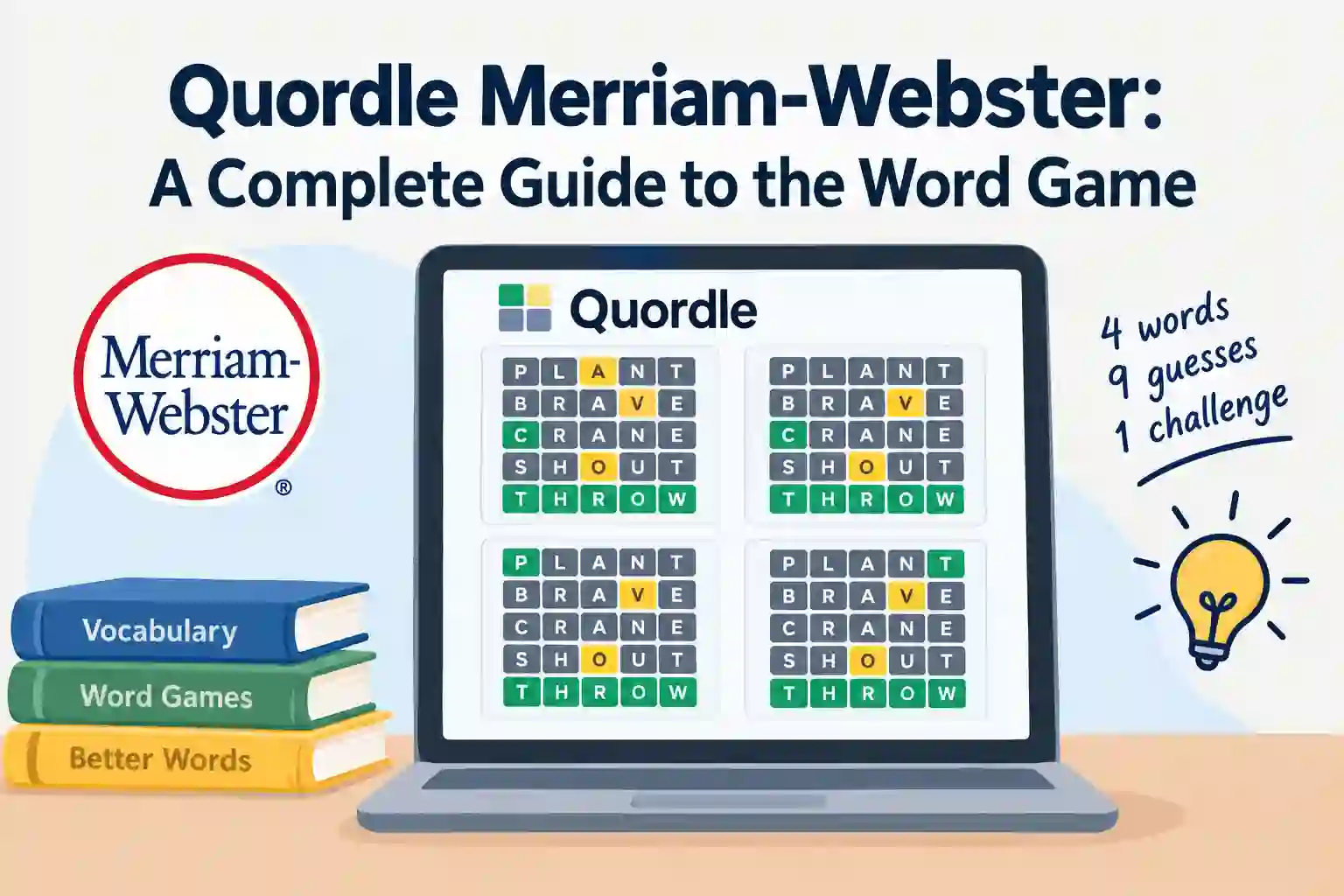
Quordle Merriam-Webster is a popular word puzzle that challenges players to solve four hidden words. Unlike Wordle, it requires several answers at the same time. That difference makes each guess more important and creates a deeper puzzle experience. Players must watch four boards while managing a limited number of attempts. For many word-game fans, this format feels more demanding without becoming difficult to understand.
The challenge can become confusing for new players because every guess affects four puzzles. A strong opening word may reveal useful letters on one board while helping very little elsewhere. Therefore, players need a clear method rather than random guesses. This type of shared puzzle format also fits well with other classroom games that encourage quick thinking, vocabulary, and problem-solving. Understanding the rules, color clues, word patterns, and Merriam-Webster connection can make the experience much easier. This guide explains those details in simple terms.
What Is Quordle Merriam-Webster?
The Basic Idea Behind Quordle
Quordle Merriam-Webster refers to the Quordle word puzzle available through Merriam-Webster. The game builds on the familiar word-guessing format made popular by Wordle. However, Quordle gives players four separate five-letter words to solve during the same round. Every accepted guess appears across all four puzzle boards.
The player normally receives nine guesses to find all four answers. This creates an interesting balance between speed and careful thinking. A guess can reveal several useful letters at once. However, a weak guess can also consume an important attempt. Merriam-Webster describes Quordle as a daily word game with four puzzles played together.
How the Four Boards Work
Each Quordle board represents a different hidden five-letter word. The boards use the same guesses, but their answers are different. Letter colors help players understand what each guess reveals about each answer. A green letter appears in the correct position, while a yellow letter appears in the word but has another position.
Gray letters generally show that a letter does not appear in the relevant answer. Therefore, players should read each board separately after every guess. One letter can receive different feedback on different boards. This makes careful observation one of the most important skills in the game.
Why Merriam-Webster Matters
Merriam-Webster is widely known for its dictionaries and language resources. Its involvement gives Quordle a strong connection with vocabulary and word knowledge. The company provides Quordle alongside other word-focused games and language tools. Players therefore encounter the puzzle within a broader environment built around words and learning.
The Merriam-Webster connection also helps explain why vocabulary matters so much. Players do not need to memorize rare dictionary terms to succeed. Still, knowing common word patterns can provide a major advantage. Familiarity with prefixes, endings, vowels, and common letter combinations often helps narrow possible answers.
How Does Quordle Merriam-Webster Work?
Starting a Daily Puzzle
A daily Quordle round begins with four hidden five-letter answers. The player enters one valid five-letter word as the opening guess. That word is then checked against all four boards. Each board provides its own color clues based on its hidden answer.
The opening guess should usually contain several common letters. Vowels can also provide useful information early in the round. However, no single opening word guarantees success. The best choice depends on how effectively it reveals information across all four puzzles.
Understanding Green Letters
A green tile provides the strongest type of letter information. It means the letter is correct and occupies the correct position. Players should normally keep that letter fixed in later guesses. However, another board may place the same letter somewhere else.
Green letters become especially useful when several positions are confirmed. For example, a pattern such as S _ A _ E can reduce the number of possible words. Players can then focus on words that match the known structure. This process is much more reliable than guessing unrelated words.
Understanding Yellow and Gray Letters
Yellow letters show that a letter exists within the answer. However, the letter appears in the wrong position. Players should move that letter during later guesses instead of removing it. This clue becomes valuable when several yellow letters appear together.
Gray letters generally indicate that the letter is absent from that board’s answer. Players can then avoid using that letter again for that specific puzzle. However, the same letter may still matter on another board. Therefore, each board needs separate attention even though every guess is shared.
Why Is Quordle Harder Than Wordle?
Four Answers Create More Pressure
The biggest difference comes from solving four answers instead of one. In a standard Wordle-style puzzle, every guess supports one hidden word. In Quordle, each guess must be considered across four boards. As a result, players constantly switch between different letter patterns.
This extra layer creates pressure because nine guesses must cover four answers. Some boards may become nearly solved while another remains uncertain. Players must resist spending too many guesses on one easy board. Instead, each guess should ideally provide useful information across the remaining puzzles.
Shared Guesses Change the Strategy
A shared guess can be extremely powerful when used correctly. One word might test several common vowels and consonants at once. It can also reveal whether a suspected letter belongs in multiple answers. Therefore, information gathering becomes more important than immediately solving one board.
Players should also avoid repeating letters without a reason. Repeated guesses can waste opportunities when several unknown letters remain. However, repeated letters sometimes become necessary when the pattern strongly suggests them. Good play depends on using the available evidence rather than following one fixed rule.
Vocabulary Knowledge Can Help
A broad vocabulary can make Quordle easier because players recognize possible word patterns faster. Knowledge of common endings can also reduce uncertainty. Examples include patterns ending with “-ing,” “-ed,” “-er,” or “-ly.” Not every five-letter answer follows these patterns, but common structures can guide useful guesses.
Still, vocabulary alone does not guarantee success. Players also need strong deduction skills. A person may know many words but still lose by overlooking a yellow letter. Conversely, a player with ordinary vocabulary can perform well through careful elimination and pattern recognition.
The Best Strategy for Playing Quordle Merriam-Webster
Use an Information-Rich Opening Word
An effective opening word should reveal useful information rather than chase one specific answer. Many players prefer words containing several common vowels and consonants. The goal is to discover which letters appear across the four boards.
There is no universally perfect opening word. Different players may prefer different combinations based on their vocabulary. More importantly, the first guess should create information for later decisions. A good opening move can reduce uncertainty across multiple boards at once.
Track Each Board Separately
Players should mentally separate the four puzzles after every guess. A letter marked green on one board does not automatically occupy that position elsewhere. Likewise, a gray letter on one board may appear in another answer.
A simple note-taking method can help with difficult rounds. Players can record confirmed letters and rejected letters for each board. This approach reduces memory mistakes and makes complicated patterns easier to manage. It also helps when several boards contain similar letters.
Solve the Most Informative Board First
Sometimes one board becomes much clearer than the others. Solving that board can reduce mental pressure and confirm several letters. However, players should not spend every remaining guess on a single puzzle. The other boards still require enough attempts.
A useful approach is to alternate between solving and testing. One guess can target a nearly complete answer. The next can investigate an uncertain board. This balanced strategy keeps information moving across the entire puzzle.
Common Mistakes Quordle Players Should Avoid
Guessing Random Words
Random guessing rarely produces the best results in a limited-attempt puzzle. Every attempt should have a clear purpose. It should confirm a position, test new letters, or narrow the possible answer list.
Players sometimes guess a word simply because it fits one board. That approach can create problems when the same guess provides no new information elsewhere. A stronger method considers all four boards before submitting the word.
Ignoring Yellow Letters
Yellow letters are easy to overlook during a busy round. Players may remember the letter but forget that its position was incorrect. This mistake can lead to repeated placement and wasted guesses.
A yellow letter should remain part of the working puzzle. Its position should change in future guesses. When several yellow letters appear together, they can also reveal useful combinations. Careful tracking often turns confusing feedback into a clear pattern.
Forgetting Possible Repeated Letters
Some five-letter words contain repeated letters. Players may reject a correct answer because they assume every letter appears once. That assumption can cause unnecessary confusion.
Repeated letters should be considered when the available clues support them. A confirmed pattern may sometimes leave only words containing a duplicate letter. Therefore, players should remain flexible instead of applying rigid rules.
How Quordle Supports Vocabulary Skills
Learning Through Word Patterns
Quordle can naturally expose players to different word structures. Repeated gameplay helps people recognize common combinations faster. Over time, patterns such as consonant clusters and vowel placements may become easier to spot.
This learning process does not require formal study. Players encounter words through repeated puzzle solving. When an unfamiliar answer appears, the player may also become curious about its meaning. That can turn a short puzzle into a small vocabulary lesson.
Building Pattern Recognition
Pattern recognition is one of the strongest skills developed through word puzzles. Players learn to compare known letters with possible positions. They also become better at eliminating impossible combinations.
Quordle makes this process more demanding because four patterns develop together. Players must quickly identify which board has the most useful clues. With practice, that process can become faster and more natural.
Making Language Practice More Engaging
Traditional vocabulary exercises can feel repetitive for some learners. Word puzzles offer a more interactive alternative. The player receives immediate feedback after each guess, which keeps the activity active and focused.
However, Quordle should not replace structured language learning. It works better as a casual supplement. Players can use the game for vocabulary exposure while relying on dictionaries and reading for deeper understanding.
What Makes Merriam-Webster Quordle Different?
A Familiar Word-Game Format
The puzzle uses a format that many word-game fans already understand. Players enter five-letter words and receive visual clues. Therefore, beginners can understand the basic mechanics quickly.
The challenge comes from the four-board format rather than complicated controls. Players can focus on language and deduction instead of learning a complex game system. That simple design helps explain why the format remains approachable.
A Strong Language Brand
Merriam-Webster has a long history in dictionary publishing and language resources. Its brand is closely associated with definitions, spelling, vocabulary, and word usage. Quordle fits naturally within that language-focused environment.
The association also gives players a familiar place to explore unfamiliar words. When a puzzle answer seems unusual, a dictionary can provide useful context. This creates a natural connection between playing a puzzle and exploring language.
A Daily Puzzle Routine
Daily puzzles can become easy habits because each round offers a fresh challenge. Players can return regularly without needing a long gaming session. The short format makes the game suitable for breaks, mornings, or casual evening play. This style also connects with broader gaming trends where simple browser games continue to attract people who want quick entertainment.
However, the daily structure can create pressure for competitive players. The best approach remains focused on solving accurately rather than rushing.
Is Quordle Merriam-Webster Free to Play?
Access to the Daily Game
The daily Quordle puzzle has been offered as a browser-based word game through Merriam-Webster. Players can access the game through the company’s website and begin solving the daily challenge.
Because websites can change their features, access details may vary over time. Players should check the official Merriam-Webster Quordle page for the current experience. That page provides the most reliable information about the available game and its features.
Browser-Based Convenience
One major advantage of a browser puzzle is simple access. Players generally do not need specialized gaming hardware. A compatible device and internet connection can provide access to the puzzle.
This makes the game suitable for computers, tablets, and many smartphones. The exact interface can vary by device. Still, the core puzzle concept remains focused on entering words and reading the resulting clues.
Checking the Official Source
The official Merriam-Webster website remains the best source for current Quordle information. Its Quordle page provides access to the game and related information. Players should rely on official pages when checking current rules or availability.
Merriam-Webster also provides extensive dictionary resources. Its online dictionary can help players explore unfamiliar words. That makes the platform especially useful for people who enjoy combining puzzles with vocabulary discovery.
Tips for Getting Better at Quordle
Focus on Information Before Speed
Fast guessing does not always lead to better results. A thoughtful guess can reveal more information than several rushed guesses. Therefore, players should consider what each word can teach them before submitting it.
This approach becomes increasingly valuable when two or three boards remain uncertain. The player can choose a word that tests several possible letters. Even when that word does not solve anything, it may create enough evidence for the next move.
Watch the Remaining Possibilities
Every clue reduces the number of possible answers. Players should use that reduction rather than relying only on memory. Once several positions become known, the remaining possibilities can become surprisingly small.
Dictionary knowledge can help when several uncommon options remain. Merriam-Webster’s dictionary and word resources can provide definitions and spelling information. However, the actual puzzle solution should still come from the game’s clues.
Keep a Calm Solving Process
Quordle can feel difficult when several boards produce mixed clues. Panic often causes players to ignore information they already discovered. A calm process helps preserve useful evidence.
Players can review each board after every guess. They can identify green letters, reposition yellow letters, and remove gray letters. Then they can choose the next word based on the strongest evidence. This simple routine can improve consistency without requiring advanced techniques.
Frequently Asked Questions
What is Quordle Merriam-Webster?
Quordle is a daily word puzzle presented through Merriam-Webster. It asks players to solve four five-letter words using the same set of guesses. The shared guessing system makes it more complex than a single-word puzzle.
How many words must players solve in Quordle?
Players must solve four hidden five-letter words in each standard round. All four boards use the player’s submitted guesses. Each board provides separate color feedback for its answer.
How many guesses does Quordle give players?
The standard Quordle format provides nine guesses for solving four words. This limited number makes every guess important. Players therefore benefit from choosing words that provide useful information.
Is Quordle harder than Wordle?
Quordle is generally more demanding because four answers must be solved together. The player must track multiple sets of clues at once. However, people familiar with word puzzles can learn its system quickly.
What do green letters mean in Quordle?
A green letter means the letter matches the answer and occupies the correct position. Players should normally keep that letter in the same position. Green clues are especially useful when several letters form a recognizable pattern.
What do yellow letters mean in Quordle?
A yellow letter means the letter belongs in the answer but sits in the wrong position. The player should move that letter in later guesses. Yellow clues can become very powerful when combined with green letters.
Is Quordle connected to Merriam-Webster?
Yes. Quordle is part of Merriam-Webster’s collection of word games. Merriam-Webster provides the current official platform where players can access the puzzle.
Can Quordle improve vocabulary?
Quordle can support vocabulary development through repeated exposure to words and spelling patterns. Players may encounter unfamiliar words during regular gameplay. However, deeper vocabulary learning still benefits from reading, definitions, and broader language practice.
Final Thoughts on Quordle Merriam-Webster
Quordle Merriam-Webster offers a more demanding version of the familiar daily word puzzle. Its four-board format requires players to manage clues across several answers. At the same time, the rules remain simple enough for new players to understand quickly. Strong results usually come from careful observation, useful guesses, and steady elimination.
The game also fits naturally within Merriam-Webster’s wider language-focused platform. Players can enjoy a daily challenge while exploring spelling, vocabulary, and word patterns. For anyone interested in improving puzzle-solving skills, Quordle provides a practical and engaging way to practice. Readers can visit Merriam-Webster’s official Quordle page and explore the current daily puzzle for themselves.
3 thoughts on “Quordle Merriam-Webster: A Complete Guide to the Word Game”