
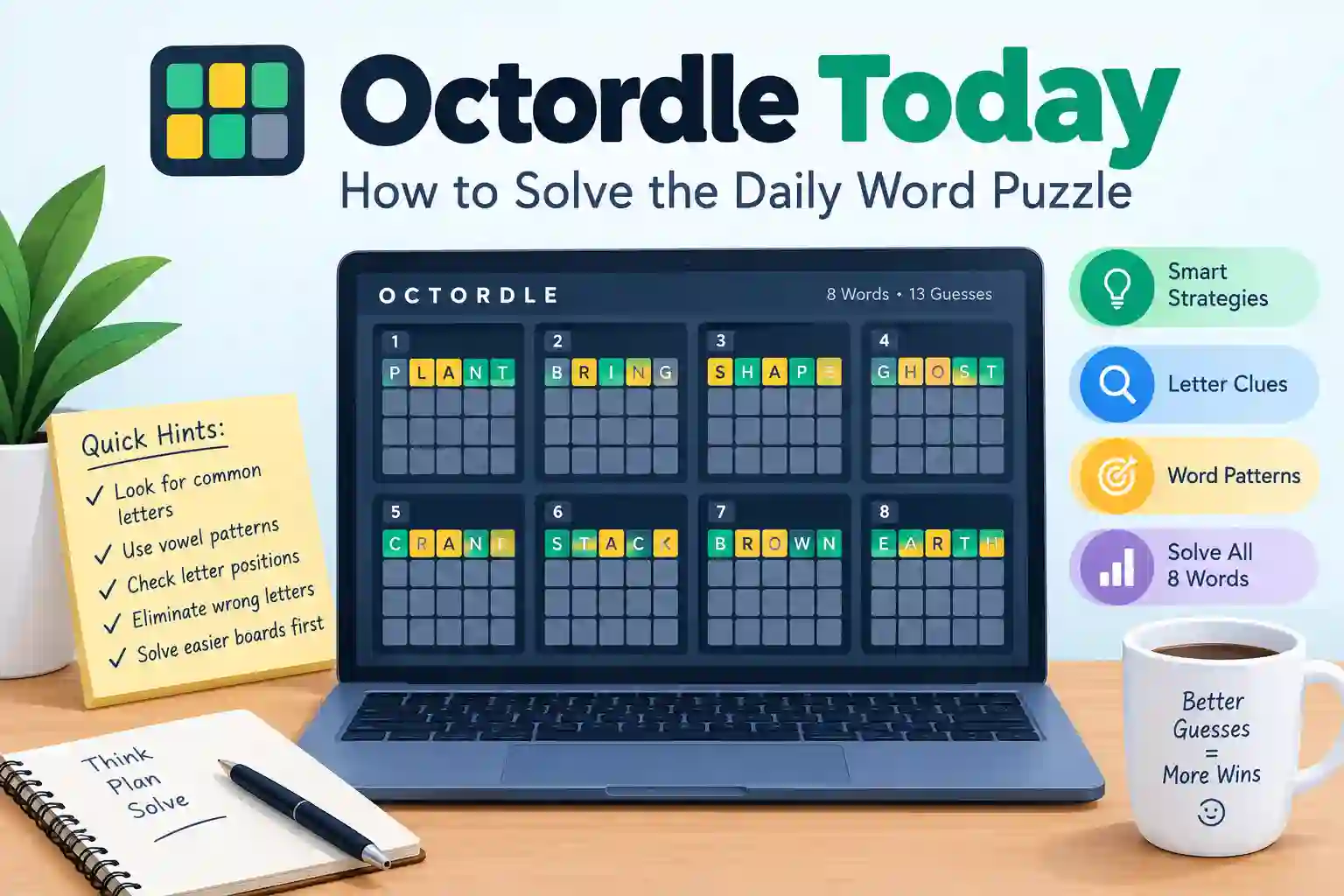
Searching for octordle today usually means a player wants help with the current daily word puzzle. Octordle gives players a much harder challenge than many familiar word games. Instead of finding one hidden word, players must solve eight words during the same game. That creates more pressure because every guess can affect several boards at once. A player may understand the rules yet still struggle when several words look similar.
The difficulty becomes greater when useful letters appear in different positions. Players can also lose valuable guesses by testing words that provide little information. Therefore, random guessing often makes the puzzle harder than necessary. A better approach uses letter patterns, repeated clues, word structure, and careful guess selection. Players who enjoy similar daily word challenges can also explore Quordle Merriam-Webster to compare another multi-word puzzle experience. This guide explains how Octordle works and how players can approach each daily puzzle with greater confidence.
What Is Octordle Today?
The Basic Octordle Format
Octordle today refers to the current daily Octordle puzzle available for players to solve. The central challenge involves eight hidden five-letter words. Players work across eight puzzle boards while sharing the same limited number of guesses. Each guess is entered across all active boards, which makes every word choice important.
The familiar color clues help players understand each result. A correct letter in the correct position receives one type of positive clue. A correct letter in the wrong position receives another clue. Letters that do not belong to the target word receive a negative clue. Because eight boards update together, one strong guess can reveal useful information across several puzzles.
How the Eight Boards Work
The eight boards are usually presented together so players can track their progress. Each board can develop at a different speed during the same game. One word might become obvious after a few guesses, while another can remain uncertain until the final attempts. Players therefore need to manage attention instead of solving every board in exactly the same order.
A useful habit involves watching the boards that contain the most information. For example, one board may show four confirmed letters while another shows only one. The nearly completed board deserves attention because its remaining possibilities are easier to narrow. However, the unfinished boards should not be ignored because shared guesses can still provide valuable clues.
Why Octordle Feels Harder Than Wordle
Wordle asks players to identify one five-letter word from a limited number of guesses. Octordle multiplies that challenge by requiring eight answers within a larger but still restricted guess limit. The player must think about several word patterns simultaneously. This creates a different mental task from solving a single daily word puzzle.
Furthermore, a guess can be excellent for one board but weak for another. That difference forces players to think about information rather than immediate answers. A strong Octordle player does not always choose the word that seems closest to one solution. Instead, the player often chooses a word that can reveal useful letters across multiple unsolved boards.
How to Read Octordle Clues Correctly
Understanding Correct-Position Letters
The most valuable clue usually comes from a letter that appears in the correct position. That result confirms both the letter and its exact location. Players should record these positions mentally or on paper before making another guess. This simple habit prevents repeated mistakes and helps create a clearer picture of each hidden word.
However, one confirmed letter does not automatically reveal the complete answer. Several five-letter words can share the same starting or ending pattern. Therefore, players should combine confirmed letters with eliminated letters and known word shapes. A pattern such as _ A _ E _ can still represent many possibilities, so additional evidence remains important.
Using Wrong-Position Letters
A misplaced letter is also valuable because it proves that the letter belongs somewhere in the target word. The challenge involves discovering where it actually fits. Players should avoid placing that letter in the same position again. Instead, the next guess can test a different location while also checking another useful letter.
This clue becomes especially helpful when several boards contain similar patterns. A misplaced vowel can narrow a word quickly because English five-letter words use vowels in predictable ways. Similarly, a common consonant can become much easier to place after several positions have been ruled out. Careful tracking turns uncertain clues into useful evidence.
Treating Gray or Absent Letters Carefully
An absent letter generally means that the tested letter does not appear in the target word. That information can remove several possible answers at once. Players should remember eliminated letters rather than accidentally testing them again. Reusing known absent letters wastes an opportunity to gather new information.
There can be an important complication with repeated letters. A word may contain the same letter more than once, while the clues can reflect the number of times that letter appears. Therefore, players should not assume that one confirmed occurrence always rules out another occurrence. Repeated-letter words require extra attention and a slower approach.
The Best Strategy for Octordle Today
Start With Information-Rich Words
The opening guess should normally reveal as much useful information as possible. Words containing several common vowels and consonants can test many possibilities at once. A good opening word does not need to resemble the final answer. Its main purpose is to expose letter patterns across the eight boards.
For example, a player can favor words that contain common letters rather than unusual combinations. Letters such as E, A, R, S, T, O, and N frequently appear in English vocabulary. Testing several useful letters early can quickly reduce the number of possible solutions. Still, players should avoid assuming that common letters must appear in every daily puzzle.
Use Different Guesses for Different Goals
Not every guess should try to solve a word immediately. Some guesses work better as information-gathering moves. A player may already have several likely letters but still lack enough information to identify the answer. In that situation, another strategic word can test multiple unknown letters.
This approach becomes especially useful when one board has several possible answers. Suppose a pattern could produce five different words. A random final guess might fail and reveal little. A carefully selected testing word can check several competing letters at once. The next guess then becomes much easier because the uncertainty has been reduced.
Solve the Easiest Boards First
Players often benefit from solving boards that have strong patterns. An almost completed word requires less mental effort than a board with only one useful clue. Solving an easier board also reduces the number of active problems. That can make the remaining puzzle feel less overwhelming.
Nevertheless, easy boards should not consume every available guess. Once a board becomes nearly certain, players can shift attention toward difficult boards. The goal is to use the shared guess system efficiently. Every move should ideally provide information that helps one or more unsolved words.
Common Mistakes Players Make
Guessing Only From One Board
One common mistake involves focusing heavily on the most interesting board. A player may notice a nearly complete word and spend several guesses trying to finish it. Meanwhile, other boards may contain clues that could help with future guesses. Since the same guess affects the entire game, isolated thinking can reduce overall efficiency.
A better method keeps all eight boards visible during every turn. The player can identify the board needing the most attention while still checking whether the planned guess helps elsewhere. This wider view is one of the main skills that separates careful Octordle play from ordinary guessing.
Repeating Unhelpful Letters
Another mistake involves using words that repeat letters already known to be useless. Once a letter has been ruled out, it should normally stay out of future guesses. Otherwise, the player spends a valuable attempt confirming something already known.
However, repeated letters can create exceptions when the board suggests that a letter may appear more than once. Players should therefore read every clue together rather than following a rigid rule. The best strategy combines elimination with pattern recognition. That balance helps avoid both careless repetition and incorrect assumptions.
Choosing Rare Words Too Early
Unusual words can sometimes solve difficult boards, but they are rarely ideal starting points. Rare letters provide less broad information when compared with common letters. A strange opening word may produce very few useful clues across the eight boards.
Therefore, most players can benefit from starting with familiar five-letter words. Once the puzzle becomes narrower, less common vocabulary becomes more relevant. The final answer may still be an uncommon word, but the clues should guide that conclusion. Strong solving relies on evidence rather than guessing what sounds unusual.
How Hints Can Help Without Giving Away the Puzzle
When a Hint Is Useful
A hint can help when a player has reached a point where several answers appear possible. This situation is common in Octordle because many English words share similar patterns. A small clue can break the tie without revealing the complete solution. For example, knowing the first letter or a vowel position can dramatically reduce the possibilities.
Hints are also useful for players who want to keep the puzzle enjoyable. A completely revealed answer removes the challenge, while a small clue preserves much of the solving process. Therefore, hints can work as a middle option between independent solving and checking the full answers.
How to Use Hints Carefully
The best time for a hint is usually after the player has already gathered substantial clues. Using a hint immediately can reduce the learning value of the puzzle. Waiting allows the player to test personal reasoning first. Then the hint can solve a specific point of confusion.
A useful rule involves asking what information is missing. If the letters are known but their positions remain unclear, a position-based hint may help. If the pattern is clear but several words remain possible, a first-letter clue may be more useful. Matching the hint to the problem keeps assistance focused.
Why Full Answers Should Be the Last Option
Checking all eight answers can save time, but it removes the main challenge of the daily puzzle. Players who regularly look up every solution may also miss opportunities to improve their vocabulary and deduction skills. Therefore, full answers are best treated as a final fallback.
For players searching octordle today, answer pages can still have a useful role. They can confirm a solution after the puzzle has been completed. They can also explain an unfamiliar word that appeared in the game. Used this way, answer resources become learning tools rather than simple shortcuts.
Building a Better Daily Octordle Routine
Keep Track of Confirmed Patterns
A consistent note-taking system can make multi-board puzzles easier. Players can mentally separate confirmed letters, misplaced letters, and eliminated letters for each board. Some players prefer a small written grid because eight boards can quickly become difficult to remember.
This method also reduces cognitive load. Instead of repeatedly asking which letters remain possible, the player can focus on word construction. Over time, the process becomes more automatic. That improvement can make future daily puzzles feel less chaotic, even when the vocabulary becomes difficult.
Think About Word Families
Word families can provide strong clues when several letters are already known. Words often share common endings such as -ING, -ED, -ER, or -LY. Five-letter answers can also share structures involving common vowel and consonant combinations.
However, players should avoid forcing a familiar ending onto every board. The clue pattern should always come first. A word family becomes useful only when it matches the available evidence. Good solving combines vocabulary knowledge with strict clue discipline.
Learn From Failed Attempts
A failed guess does not always represent wasted effort. It can reveal a missing letter, eliminate a possibility, or show that a suspected pattern was incorrect. Players should review why the guess failed rather than simply moving forward.
That review creates a useful learning cycle. The player identifies the assumption, checks the clue, and adjusts the next guess. Over several daily puzzles, this process can improve pattern recognition. Even difficult Octordle games can become easier when mistakes are treated as information.
What Makes a Good Octordle Player?
Strong Vocabulary Helps
Vocabulary knowledge naturally gives players an advantage. Someone familiar with many five-letter words can recognize possible answers faster. However, vocabulary alone does not guarantee success. The game also rewards careful deduction and efficient guess selection.
A player does not need to know every unusual English word. Instead, broad familiarity with common word patterns can provide a strong foundation. When an uncommon answer appears, the surrounding clues can often narrow the possibilities enough to identify it.
Logical Thinking Matters More Than Speed
Fast guessing can look impressive, but speed does not always produce better results. Octordle rewards decisions that maximize useful information. A slower player who carefully checks every board can often outperform someone who guesses quickly.
Therefore, players should focus on accuracy and information value. Each turn should answer a question about the puzzle. The question might involve a letter, position, vowel pattern, or possible word family. This mindset creates a more reliable solving process.
Daily Practice Builds Pattern Recognition
Regular play can improve familiarity with common five-letter structures. Players begin recognizing repeated combinations and understanding which guesses offer useful coverage. They may also become better at spotting traps caused by similar-looking words.
That improvement comes naturally through repeated exposure. A daily puzzle provides a small but consistent vocabulary exercise. Over time, players can develop better intuition without memorizing huge word lists. The strongest progress usually comes from reviewing difficult puzzles instead of only celebrating easy wins.
Frequently Asked Questions
What does Octordle today mean?
Octordle today usually refers to the current daily Octordle puzzle. Players searching this phrase often want the latest puzzle, hints, rules, or answers. The daily challenge changes, so information about one puzzle may not apply to another day.
How many words must players solve in Octordle?
Octordle requires players to solve eight hidden five-letter words. The words appear across multiple boards during the same game. Each submitted guess provides clues for the active boards.
How many guesses does Octordle give players?
The standard Octordle format gives players thirteen guesses to solve eight words. Because every guess applies across the boards, efficient guessing becomes very important. Players should therefore focus on guesses that provide broad information.
Is Octordle harder than Wordle?
Octordle is generally more demanding because it requires eight words instead of one. The player must track several clue patterns at the same time. However, the additional guesses provide some room for strategic play.
Can players play Octordle for free?
Octordle has been available as a browser-based word puzzle. Availability, features, and specific game modes can change over time. Players should check the current official Octordle site for the latest access details.
Does Octordle use the same words as Wordle?
Octordle and Wordle are separate games, so their word selections do not need to match. Both use five-letter word puzzles, but their daily challenges can differ. Players should therefore avoid assuming that a Wordle answer will work as an Octordle answer.
What is the best first guess in Octordle?
There is no single perfect opening word for every puzzle. A strong first guess usually tests several common vowels and consonants. The best choice is one that creates useful information across multiple boards.
Where can players check Octordle answers?
Players can check the official Octordle game and reputable puzzle-answer resources for daily information. However, checking answers after attempting the puzzle first can preserve the challenge. A hint is often a better choice when the goal is to keep solving independently.
Conclusion:
Octordle today is more than a search for eight hidden words. It is a puzzle built around deduction, vocabulary, pattern recognition, and efficient use of guesses. Players can improve by tracking letter positions, eliminating weak options, and choosing guesses that reveal information across several boards. A calm strategy often works better than rapid guessing.
The most useful habit involves treating every clue as evidence. Players can begin with information-rich words, solve the clearest boards, and return to difficult patterns later. When uncertainty remains, a small hint can preserve the challenge without exposing every answer. For the latest daily puzzle, players should use the official Octordle game and then apply the strategies in this guide to solve each challenge with greater confidence.