
Colon punctuation can make writing clearer, more organized, and easier to understand. However, many writers confuse colons with semicolons, commas, and dashes. These marks may look similar, but each one serves a different purpose. Using a colon incorrectly can interrupt a sentence or make a list difficult to follow.
Fortunately, learning colon punctuation does not require advanced grammar knowledge. A few simple rules can help writers introduce lists, explain ideas, present examples, and connect related information. With clear examples and regular practice, students and professionals can use colons confidently in emails, essays, reports, and everyday writing.
What Is Colon Punctuation?
Understanding the Colon Symbol
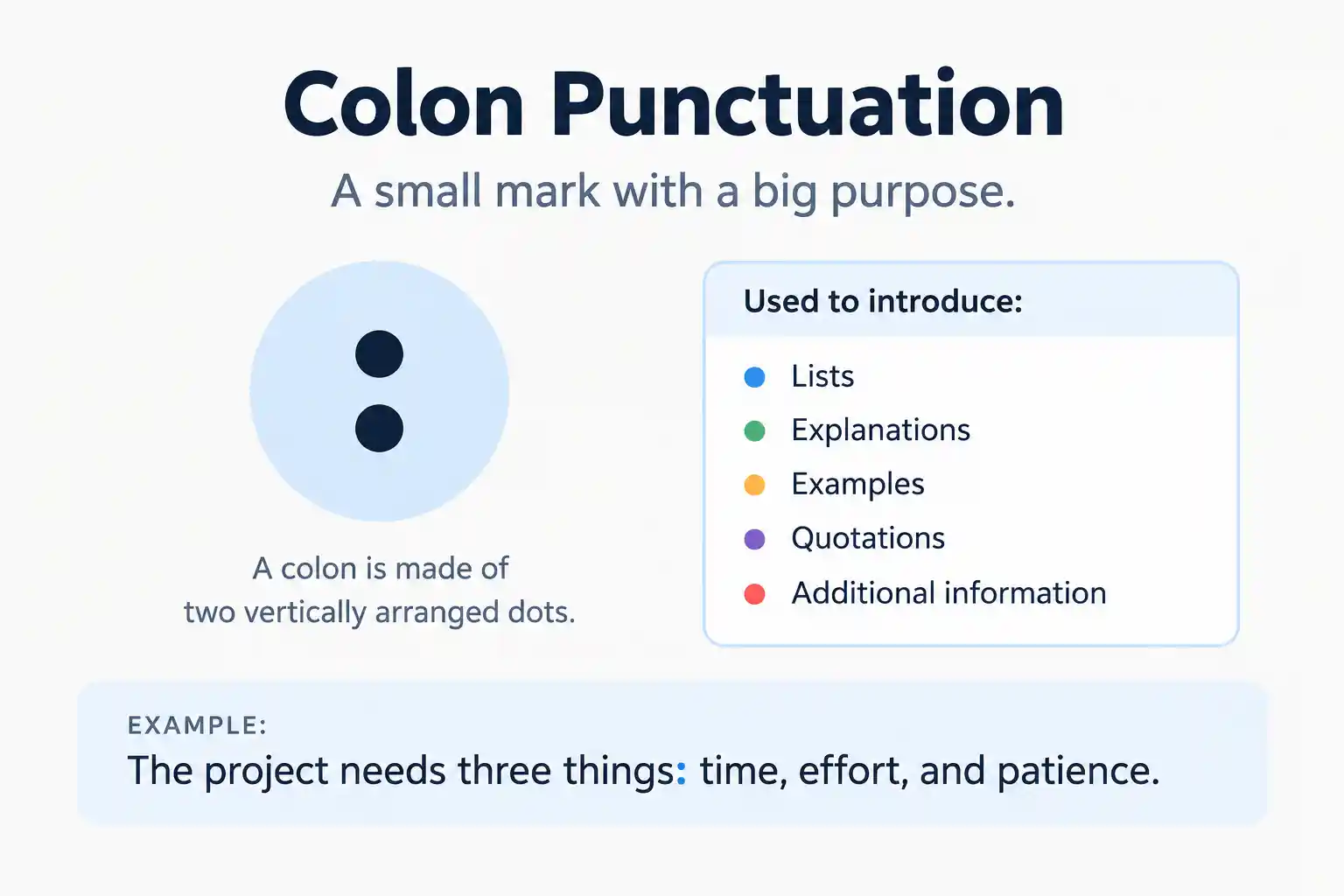
A colon is a punctuation mark made of two vertically arranged dots (:). Writers use it to introduce information that explains, expands, or supports what comes before it. For example, a sentence might introduce a list of school supplies, followed by the items themselves. The colon tells readers that additional information is coming.
Unlike a comma, a colon creates a stronger pause and signals a clear relationship between ideas. It often means that the next part will explain something already mentioned. For example, “The plan needs three things: time, effort, and patience.” The words before the colon prepare readers for the details that follow.
Why Writers Use Colons
Colons help readers understand how information fits together. They can introduce lists, examples, explanations, quotations, and other details. Therefore, they are useful in academic writing, business communication, instructions, and creative work. A well-placed colon can make a sentence easier to scan without adding unnecessary words.
However, a colon should not appear simply because a writer wants a dramatic pause. The information before it must prepare readers for what follows. When the relationship between the two parts is unclear, another punctuation mark may work better. Understanding this purpose is the first step toward using colons correctly.
The Basic Rule for Using a Colon
In standard formal writing, the words before a colon should usually form a complete sentence. This means they should express a complete thought on their own. For example, “The team agreed on one goal: better communication.” The first part makes sense independently, and the second part explains the goal.
A colon can sometimes appear in formats such as labels, schedules, headings, and tables. These uses do not always follow the same sentence structure as formal prose. Nevertheless, writers should follow the complete-sentence rule when introducing explanations or lists in ordinary writing. This simple check prevents many common punctuation errors.
How to Use Colon Punctuation Correctly
Using a Colon to Introduce a List
One common use of colon punctuation is introducing a list. The sentence before the colon should usually make sense without the listed items. For example, “The recipe requires four ingredients: flour, milk, eggs, and sugar.” The opening statement introduces the idea, while the list provides the promised details.
A colon is generally unnecessary when a list directly completes a sentence. For example, “The ingredients include flour, milk, eggs, and sugar” does not need a colon. The word “include” already connects the sentence to the items. Adding a colon after “include” would separate the verb from its objects incorrectly.
Using a Colon to Explain an Idea
A colon can introduce information that explains a statement. For example, “The meeting ended early: everyone had completed the required tasks.” The second part explains why the meeting ended early. This structure helps readers understand the relationship between the two ideas without requiring a longer explanation.
Writers can also use colons to reveal a result, reason, or important detail. For example, “One problem remained: the final report was missing.” The first part introduces an issue, and the second identifies it. Digital communication follows a similar principle because short expressions can have different meanings depending on context. Readers can learn more through this guide to what FS means in text. In both cases, understanding the surrounding words helps prevent confusion.
Using a Colon to Introduce Examples
Colons can introduce examples that clarify a general statement. For instance, “Several outdoor activities suit beginners: walking, cycling, and easy hiking.” The general idea appears first, followed by examples that make it more specific. This arrangement helps readers understand the statement without searching through a long sentence.
However, a colon should not automatically follow phrases such as “for example” or “such as.” Consider the sentence, “Outdoor activities such as walking and cycling can suit beginners.” No colon is needed because the examples fit naturally into the sentence. A colon works best when the opening statement prepares readers for a separate explanation or list.
Colon Punctuation in Different Types of Writing
Using Colons in Academic Essays
In academic writing, colons can introduce evidence, examples, and explanations. A writer might state a main point before presenting supporting details. For example, “The survey revealed one clear pattern: students preferred shorter study sessions.” The structure helps readers identify the main claim and its supporting information.
Academic writers should use colons carefully because excessive punctuation can make an essay feel choppy. A colon should clarify the relationship between ideas rather than decorate a sentence. Furthermore, students should follow their teacher’s required style guide. Different academic styles may have specific rules for capitalization, quotations, and formatting after a colon.
Using Colons in Business Writing
Business communication often uses colons to organize information efficiently. They appear in reports, meeting notes, announcements, and formal messages. For example, “The project has three priorities: quality, timing, and cost.” The sentence gives readers a clear overview before presenting more detail.
Colons also help introduce explanations in professional emails. For example, “One item needs attention: the updated invoice has not arrived.” This structure makes the main issue easy to identify. Clear communication also matters in informal messages, where abbreviations can confuse readers. The guide to POS meaning in slang explains how context helps people interpret short expressions correctly. Business writers should still avoid placing colons after incomplete introductory phrases.
Using Colons in Creative Writing
Creative writers sometimes use colons to create emphasis or reveal important information. A character might make a statement before explaining a surprising detail. For example, “She knew what mattered most: protecting her family.” The colon creates a pause that directs attention toward the final phrase.
Nevertheless, creative writing benefits from variety. Too many colons can make a story feel overly formal or mechanical. Writers can use periods, commas, and dashes when those marks better match the sentence’s rhythm. The best punctuation supports the intended meaning and tone rather than following a repeated pattern.
Colon vs. Semicolon, Comma, and Dash
Colon vs. Semicolon
A colon usually introduces information that explains or expands the preceding statement. A semicolon, by contrast, connects two closely related independent clauses. For example, “The forecast was clear: the outdoor event could continue.” The second part explains the first statement, so the colon fits naturally.
Now consider this sentence: “The forecast was clear; the outdoor event could continue.” The semicolon connects two complete, closely related thoughts. It does not specifically announce an explanation in the same way. Both versions may work, but the colon emphasizes the relationship between the forecast and the decision.
Colon vs. Comma
A comma usually creates a smaller pause or separates parts within a sentence. A colon signals that readers should expect a list, explanation, or related detail. For example, “The box contained three items: a notebook, a pen, and a ruler.” The colon introduces the complete list.
A comma cannot always replace a colon without changing the sentence structure. For example, “The box contained three items, a notebook, a pen, and a ruler” may be confusing without additional wording. A colon makes the list’s purpose clearer. However, commas remain correct when separating items within a list or joining introductory phrases to the rest of a sentence.
Colon vs. Dash
A dash can introduce an explanation or create emphasis, much like a colon. However, a dash often feels more conversational or dramatic. For example, “The answer was simple: practice every day.” The colon presents the answer in a direct, structured way.
The sentence could also read, “The answer was simple—practice every day.” The dash creates a stronger sense of interruption or emphasis. In formal reports, a colon may be the safer choice for introducing organized information. In informal writing, a dash may better match the writer’s voice. Neither mark should replace the other automatically.
Special Rules for Colon Punctuation
Capitalization After a Colon
Whether the first word after a colon begins with a capital letter depends partly on the writing style. Many styles use lowercase when the colon introduces a phrase or a list. For example, “The bag contained three items: a book, a pen, and a folder.” The list continues the sentence rather than starting a new one.
Capitalization rules can differ when a colon introduces a complete sentence. Some style guides recommend a capital letter in that situation, while others use lowercase unless a proper noun requires capitalization. Writers should follow the rules required by their school, publisher, or organization. Consistency matters more than mixing different style conventions in one document.
Using Colons Before Quotations
A colon can introduce a quotation when the preceding sentence prepares readers for it. For example, “The report offered this advice: ‘Small changes can create lasting progress.’” The first part introduces the quotation, and the quoted words provide the message. This structure often works well in formal writing.
However, a colon is not necessary before every quotation. If quoted words fit naturally into a sentence, a comma or no introductory punctuation may be more appropriate. For example, “The coach said, ‘Practice begins at nine.’” The correct choice depends on the sentence structure and the required style guide.
Using Colons in Time, Ratios, and Titles
Colons appear in several common formats outside ordinary sentences. In time notation, they separate hours from minutes, as in 8:30. In mathematical ratios, they can express relationships such as 2:1. Writers also use colons to separate titles from subtitles, as in Clear Writing: A Practical Guide.
These uses follow conventions that differ from ordinary sentence punctuation. For example, a ratio does not need a complete sentence before the colon. Similarly, a title can use a colon to separate the main title from additional information. Recognizing these special cases prevents writers from applying sentence rules where they do not belong.
Common Colon Punctuation Mistakes
Placing a Colon After an Incomplete Phrase
One frequent mistake is placing a colon after a phrase that cannot stand alone as a sentence. For example, “The required supplies are: paper, scissors, and glue” is generally incorrect in formal prose. The word “are” connects the subject to the list, so the colon interrupts the sentence unnecessarily.
A better version is, “The required supplies are paper, scissors, and glue.” Another option is, “The project requires three supplies: paper, scissors, and glue.” The second version places a complete thought before the colon. This small change creates a clearer and more grammatically sound sentence.
Using Too Many Colons
A colon can improve clarity, but repeated use may make writing difficult to read. Consider a paragraph where every sentence introduces another list or explanation. Readers may struggle to follow the main point because each sentence uses the same structure. Therefore, punctuation variety can improve the flow of longer passages.
Writers should check whether a period or simpler sentence would communicate the same idea. For example, a long sentence containing several explanations might work better as two shorter sentences. A colon should highlight a meaningful connection, not replace every possible pause. Careful editing helps maintain a natural rhythm.
Confusing Colons With Semicolons
Colons and semicolons look similar, but their functions differ. A colon introduces information, while a semicolon usually connects related independent clauses. Confusing the two can weaken a sentence’s meaning or structure. For example, a list usually needs a colon after a complete introductory statement, not a semicolon.
A useful editing method is to identify the relationship between the two parts. If the second part explains, names, or expands the first, a colon may be suitable. If both parts are complete sentences with a close connection, a semicolon may work. The surrounding words determine the best choice, not the mark’s appearance.
How to Improve Colon Punctuation Skills
Read the Sentence Before Adding a Colon
Before inserting a colon, writers should read the opening words independently. If they express a complete thought, the colon may be appropriate for introducing further information. If they leave readers waiting for the rest of the sentence, another structure may be needed. This simple check can prevent many punctuation errors.
Next, writers should examine the information after the colon. It should explain, expand, or identify something connected to the opening statement. For example, “The solution was clear: the team needed better planning.” The second part explains the solution. When this connection feels weak, rewriting the sentence may improve clarity.
Practice With Everyday Examples
Regular practice helps writers recognize suitable colon placement. Simple examples from schoolwork, emails, recipes, and reports can make the rule easier to remember. For instance, “The trip requires three items: water, comfortable shoes, and sunscreen.” The sentence introduces a clear list after a complete statement.
Writers can also practice correcting mistakes in everyday communication. For example, they might change “The goals are: save money and reduce waste” to “The goals are to save money and reduce waste.” Understanding online messages also requires attention to context and wording. Readers can explore what does WYLL mean to learn how abbreviations work in casual digital conversations. These examples show why clear wording matters in both formal writing and everyday chats.
Use Reliable Grammar References
Grammar guides can help writers check punctuation rules when a sentence feels uncertain. Purdue University’s Online Writing Lab offers guidance on punctuation and academic writing. The Purdue OWL writing resources explain common punctuation choices and their functions. Such references are useful for students, teachers, and professional writers.
Style guides also help when capitalization or quotation rules differ. A school may follow MLA guidance, while a workplace may use AP or Chicago style. Therefore, a writer should identify the required style before editing a long document. Using one consistent reference helps avoid unnecessary changes and improves the final result.
Frequently Asked Questions
What Is Colon Punctuation Used For?
Colon punctuation introduces lists, explanations, examples, quotations, and other related information. It signals that the next part expands on the preceding statement. In formal prose, the words before the colon should usually form a complete sentence.
What Is an Example of a Colon in a Sentence?
An example is, “The recipe needs three ingredients: flour, water, and salt.” The first part introduces the topic, while the list names the ingredients. This structure makes the information easy to understand.
Can a Colon Come After the Word “Is”?
A colon can follow “is” only when the sentence structure supports it. In ordinary prose, “The answer is: patience” is generally better written as “The answer is patience.” A colon may work after a complete statement that introduces an explanation or list.
Should the First Word After a Colon Be Capitalized?
Capitalization depends on the applicable style guide and the words that follow. Many styles use lowercase for lists and phrases, while rules may differ for complete sentences. Proper nouns always retain their required capitalization.
What Is the Difference Between a Colon and a Semicolon?
A colon introduces information that explains or expands the preceding statement. A semicolon connects closely related independent clauses. The correct mark depends on how the ideas relate and how the sentence is built.
Can a Colon Introduce a List?
Yes, a colon can introduce a list when the preceding words form a complete thought. For example, “The desk contains three supplies: paper, pens, and folders.” A colon is generally unnecessary when the list directly completes an introductory phrase.
Can a Colon Be Used Before a Quote?
Yes, a colon can introduce a quotation when the preceding sentence sets it up. For example, “The sign carried one message: ‘Keep the door closed.’” However, quotations that fit directly into a sentence may require different punctuation.
How Can Writers Avoid Colon Punctuation Mistakes?
Writers should check whether the words before the colon form a complete sentence. They should also confirm that the following information explains or expands the opening thought. Finally, reviewing a trusted grammar guide can help resolve style-specific questions.
Conclusion:
Colon punctuation becomes easier when writers understand its main purpose. It introduces information that explains, expands, or supports a preceding statement. It also helps organize lists, quotations, titles, and other structured details. By distinguishing colons from commas, semicolons, and dashes, writers can make their sentences clearer and more effective.
The best way to improve is to practice with real sentences and review each punctuation choice carefully. Writers should check sentence completeness, the relationship between ideas, and any required style rules. For further guidance, explore a trusted grammar reference such as Purdue OWL and apply its examples to everyday writing. Consistent practice can make accurate punctuation feel natural.