
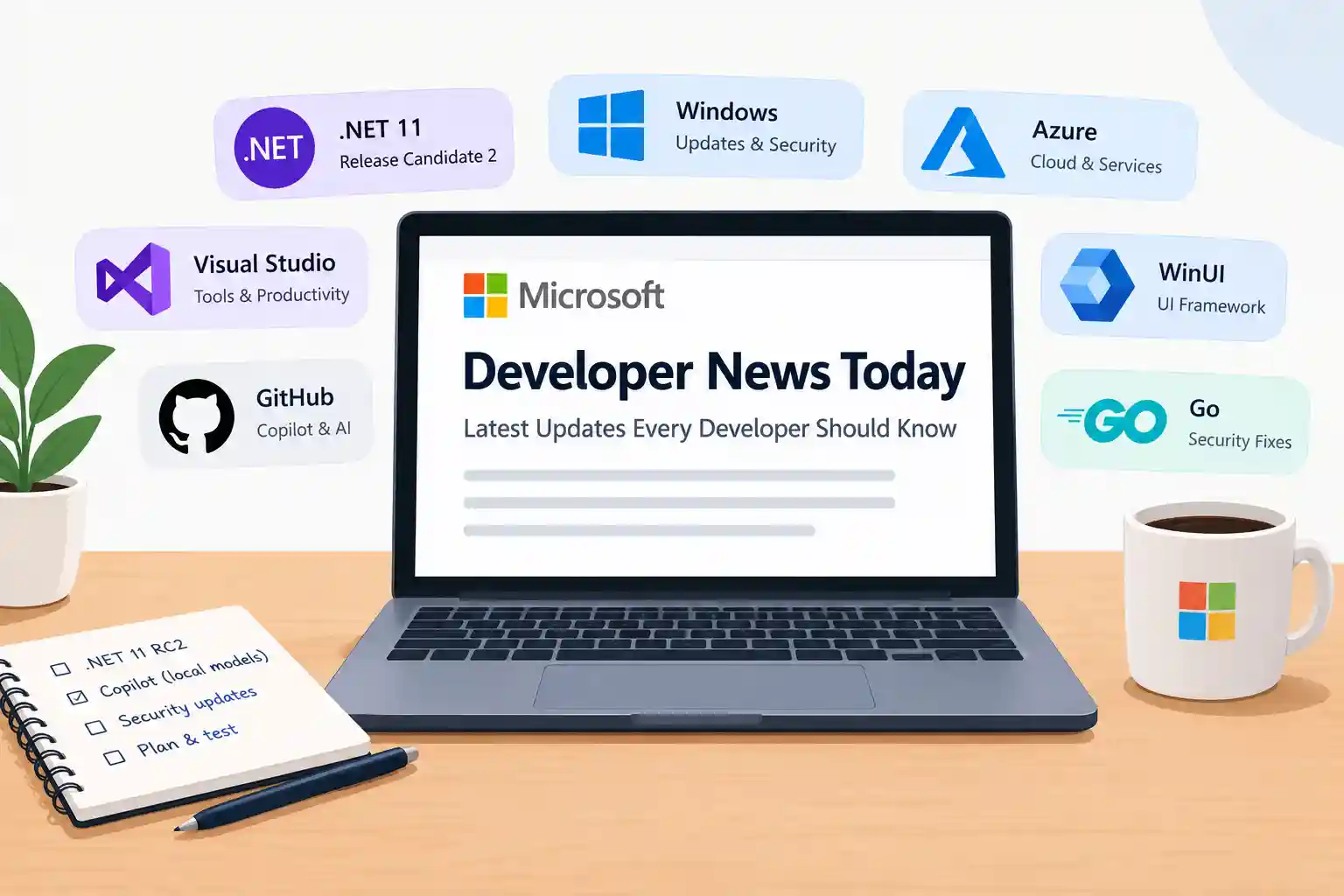
Keeping up with Microsoft developer news today feels like drinking from a fire hose. Microsoft ships updates to .NET, Windows, Azure, Visual Studio, and GitHub almost every day. Developers who miss one notice can face broken builds, security gaps, or surprise deadlines. Many readers also scan the latest technology news sites. Even so, they often miss the details that matter for real code.
Today, October 14, 2026, the pace is even faster. A record security release landed yesterday. A new .NET build reached the release candidate stage. GitHub Copilot is also moving toward local AI models on Windows. This guide solves the overload problem. It sorts the biggest Microsoft developer announcements into clear sections. It explains why each one matters and lists simple next steps for this week.
What Is Happening in Microsoft Developer News Today
As of October 14, 2026, the Microsoft Developer Blogs show a busy week. .NET 11 Release Candidate 2 arrived on October 13. WinUI Gallery 3.0 launched the same day. Microsoft also published new Go builds with security fixes. Another notice warns that older file links in Microsoft Graph will stop working in 2027. Each post looks small alone. Together, they show where the platform is heading. They also tell developers what to test first.
Three themes connect these updates. First, AI tools are moving closer to the developer’s own PC. Second, security and lifecycle deadlines keep getting tighter. Third, core frameworks keep improving in steady, practical ways. Understanding these themes helps readers separate noise from signal. Instead of reading every post, a developer can ask one question. Does this change my code, my tools, or my deadlines this quarter? If yes, it deserves attention today.
Fresh Posts From the Microsoft Dev Blogs
The Microsoft Dev Blogs gather posts from many teams in one feed. On October 13, the feed included .NET, WinUI, Go, and Microsoft 365 items. It also highlighted Windows ML, which now has experimental llama.cpp support for running GGUF models locally. GGUF is a common file format for local AI models. Another post introduced WinDbg MCP, a natural-language helper for debugging. These posts show that Microsoft’s developer news covers far more than one language or tool.
The Three Themes Behind the Headlines
Local AI, security deadlines, and framework polish appear again and again. Local AI promises lower cloud costs and faster responses. Security deadlines force teams to plan upgrades early. Framework polish rewards teams that test release candidates before the final launch. Developers who track all three themes can plan sprints with fewer surprises. In short, today’s news is less about one big launch. It is more about steady, connected change.
.NET 11 Release Candidate 2 and Framework Updates
.NET 11 Release Candidate 2 is available now. Microsoft says it brings improvements across libraries, runtime, SDK, MSBuild, NuGet, F#, ASP.NET Core, .NET MAUI, and Windows Forms. A release candidate sits close to the final version. Therefore, it is a smart time to test builds. Earlier previews already showed work on runtime-native async and C# 15 features. They also added native OpenTelemetry tracing for ASP.NET Core. Teams that waited for a stable signal can begin careful testing now.
Testing early pays off in simple ways. A team can find breaking changes before launch day. It can also check that NuGet packages and build pipelines still work. For example, a small test branch on a sample project takes an afternoon. That effort can prevent a stressful upgrade later. Moreover, early feedback helps the .NET team fix problems before the final release. Readers should still keep production apps on supported stable versions until testing is complete.
What the RC2 Release Means for Your Projects
RC2 is not a final product. It is a near-final build meant for wide testing. Developers should install the new SDK side by side with their current one. Then they should run unit tests and read the release notes. If tests fail, they should report the issue with a small sample project. This approach keeps risk low and gives the community a voice in the final version.
WinUI Gallery 3.0 and the Windows App SDK
WinUI Gallery 3.0 is the first Gallery built on the experimental channel of the Windows App SDK. It adds samples for TableView, Charts, and InkCanvas. Desktop developers can use these samples to see controls in action. However, experimental channel code can change. Therefore, teams should treat the samples as learning tools first and production templates second. Reading the sample code still saves hours of trial and error.
Go Microsoft Builds With Security Fixes
Microsoft also released Go 1.27.2-1 and 1.26.9-1 builds. These Microsoft builds of Go include security fixes. Teams that ship Go services on Azure or Linux should review the notes. Updating a patch version is usually quick. Still, a short test run is wise. Security fixes only help when they reach production, so scheduling the update this week is a good habit.
GitHub Copilot, HydraFusion, and Local AI on Windows
On October 7, Microsoft announced plans to bring local models and sandboxed tools to Windows and GitHub Copilot. The idea is simple. Copilot decides when a task suits on-device intelligence and when it needs a larger cloud model. Microsoft says this can reduce reliance on cloud computing. An experimental preview is expected later this month in the GitHub Copilot app, Copilot CLI, and Visual Studio Code. Dates can shift, so developers should confirm details on official pages.
The routing idea builds on Project HydraFusion. GitHub launched it on September 4 as a research preview in Copilot CLI. It can run one model, cascade to a stronger model, or use critique and revision. Notably, GitHub reports a 4.9-point quality gain and an estimated 67% lower cost against Claude Opus 5 on TerminalBench 2.1. Those numbers come from GitHub’s own offline tests. Independent testing has not confirmed them yet, so readers should treat them as promising claims.
How Local Models Change Everyday Coding
Local models run on the developer’s own hardware. That can mean lower latency and lower cloud bills for routine tasks. Microsoft cites PCs with NVIDIA RTX Spark and the Surface Laptop Ultra as examples. Even so, choosing a local model does not make a session fully offline, according to the official documentation. Developers with older laptops should not expect the same results as those with newer AI hardware.
Windows ML and llama.cpp Support
Windows ML is Microsoft’s runtime for running models on GPUs, NPUs, and CPUs. It now adds experimental llama.cpp support. That lets developers run open-source models through new task-specific APIs. As a result, trying a new open model takes fewer steps. Because the support is experimental, teams should avoid shipping it to customers until the APIs settle. A prototype or internal tool is a safer first target.
Cost and Token Awareness in Copilot
Copilot has moved to usage-based billing, so every token in an agent session counts. Microsoft’s developer community recently shared tips for better token efficiency in VS Code. Smart routing supports the same goal. HydraFusion charges by the tokens each model uses, at standard rates. Therefore, developers should watch their usage dashboards during any preview. A quick weekly check can prevent a surprise bill.
Security Fixes, Patch Tuesday, and Deadlines
Security headlines shape Microsoft developer news today just as much as new features. BleepingComputer reported that October 2026 Patch Tuesday fixed a record 1,411 flaws. That total includes one actively exploited zero-day and two publicly disclosed ones. Microsoft says it is using AI platforms to find and fix vulnerabilities, which helps explain the record size. Counting methods differ across outlets, so developers should read Microsoft’s own release notes for final numbers.
Large patch releases create planning problems for small teams. Microsoft tried to help this month with risk cohorts. Cybersecurity News counted 1,118 vulnerabilities across 15 risk groups in Microsoft’s briefing. The largest group covers Windows filesystems, storage, and backup, with 136 CVEs. Because of this grouping, a team can review the areas that match its own stack first. In short, cohorts turn a giant list into a manageable checklist.
Reading the Patch Numbers Carefully
Big numbers can hide the real risk. The most urgent items are the actively exploited flaw and the two public zero-days. One fixed issue was a denial-of-service flaw in MessagePack-CSharp, a library .NET developers may use. Teams should patch the urgent items first. Then they can work through the cohort that matches their products. A simple spreadsheet that tracks status also makes later audits much easier.
Moving From Tempauth URLs to Entra ID Tokens
Starting April 1, 2027, affected Microsoft Graph file APIs will stop returning pre-authenticated, or tempauth, URLs. Apps that use those APIs must authenticate with Microsoft Entra ID access tokens instead. That change needs code updates, testing, and sometimes permission reviews. Therefore, teams should search their code for tempauth usage now. Starting in 2026 leaves plenty of time for a calm, well-tested migration.
End of Updates for Older Windows Editions
BleepingComputer also reported that Windows 11 version 24H2 Home and Pro reached the end of updates on October 13, 2026. Windows 10 Enterprise LTSB 2016 reached the same milestone. Developers who test on these builds should move their test machines forward. Likewise, support teams should update customer guidance. Unsupported systems stop receiving security fixes, which raises risk quickly.
Smart Ways to Track Microsoft Developer Updates
Official sources should come first. The Microsoft Dev Blogs gather posts from many teams. The Microsoft Developer site highlights community news, such as the $100 million milestone for open source support. It also covers Visual Studio’s new Agent, which is powered by the GitHub Copilot SDK. The Build 2026 recap page lists June launches, including Microsoft Discovery general availability and Windows Developer Configurations powered by WinGet. These pages give accurate details without rumor.
Social feeds can add speed. The Microsoft Developer account on X shared the latest HydraFusion update within hours. However, short posts leave out details. Therefore, readers should open the full article before changing any code. Trusted outlets such as BleepingComputer add independent reporting, especially for security. Mixing official and independent sources gives a balanced view. It also protects teams from hype and from half-true headlines.
Best Official Sources to Bookmark
A short bookmark list saves time every morning. Each source below serves a different purpose, so none of them replaces the others. Together, they cover releases, community news, and major launches. Developers can scan them in minutes and skip the rest of the internet.
- Microsoft Dev Blogs for release posts and technical updates
- Microsoft Developer site for community news and events
- Build 2026 recap page for the biggest launches
- commandline.microsoft.com for the local models announcement
A Simple Weekly Routine for Microsoft Developer News Today
A short habit beats endless scrolling. Spend ten minutes each morning scanning the Dev Blogs. Add ten more on Friday to review security notices. Mark each item as an act now, plan soon, or ignore it. This method keeps reading focused on decisions. Over time, the routine builds real expertise because patterns become obvious.
Test AI Tools Before You Trust Them
Not every AI feature fits every team. Before adopting a new tool, compare it with other generative AI models on a small, real task. Measure quality, speed, and cost. Then write down the results for your team. For instance, local models may suit private code, while cloud models may suit complex reasoning. Fair tests beat marketing claims every time.
Frequently Asked Questions
What is the biggest Microsoft developer news today?
Three stories stand out as of October 14, 2026. They are .NET 11 Release Candidate 2, the Copilot local models plan for Windows, and the record October Patch Tuesday. Which matters most depends on your stack and deadlines.
Is .NET 11 RC2 ready for production?
A release candidate is close to final, but it is still a test build. Developers should try it in separate branches first. Production apps should stay on supported stable releases until the final version ships.
What is Project HydraFusion?
It is a GitHub Copilot research preview that combines several AI models for one coding task. It can use a single model, a cascade, or critique and revision. GitHub reports strong cost savings, but those results come from its own tests.
Will GitHub Copilot local models work fully offline?
No. Microsoft’s documentation says a local model choice does not make the whole session offline. Some parts of the workflow can still use cloud services.
When do tempauth URLs retire in Microsoft Graph?
Starting April 1, 2027, affected Microsoft Graph file APIs will stop returning pre-authenticated URLs. Apps must use Microsoft Extra ID access tokens instead. Teams should begin migration planning now.
Did Windows 11 24H2 reach the end of updates?
BleepingComputer reported that Windows 11 version 24H2 Home and Pro reached the end of updates on October 13, 2026. Windows 10 Enterprise LTSB 2016 also reached that point. Check Microsoft’s lifecycle pages for your exact edition.
Where can developers find official Microsoft developer news?
The Microsoft Dev Blogs and the Microsoft Developer site are the best starting points. The Build 2026 recap page also summarizes major launches. These sources are reliable and updated often.
How often should developers check Microsoft developer news?
A quick daily scan and a longer weekly review work well for most teams. Security notices deserve faster attention than feature announcements. A steady routine prevents both burnout and missed deadlines.
Final Thoughts on Microsoft Developer News Today
The main lesson from Microsoft developer news today is balance. New AI tools, framework releases, and security fixes all arrive at once. Developers do not need to chase every headline. They need a clear filter and a steady routine. Test .NET 11 RC2 early, watch Copilot’s local model preview, and plan the Entra ID migration. Those three actions cover a large share of this week’s risk and opportunity.
Ready to stay ahead? Bookmark the official Microsoft sources above and set a weekly review. Then return to Future Tech Guide for more clear, researched technology updates. A few focused minutes each week can keep your projects secure, current, and calm.