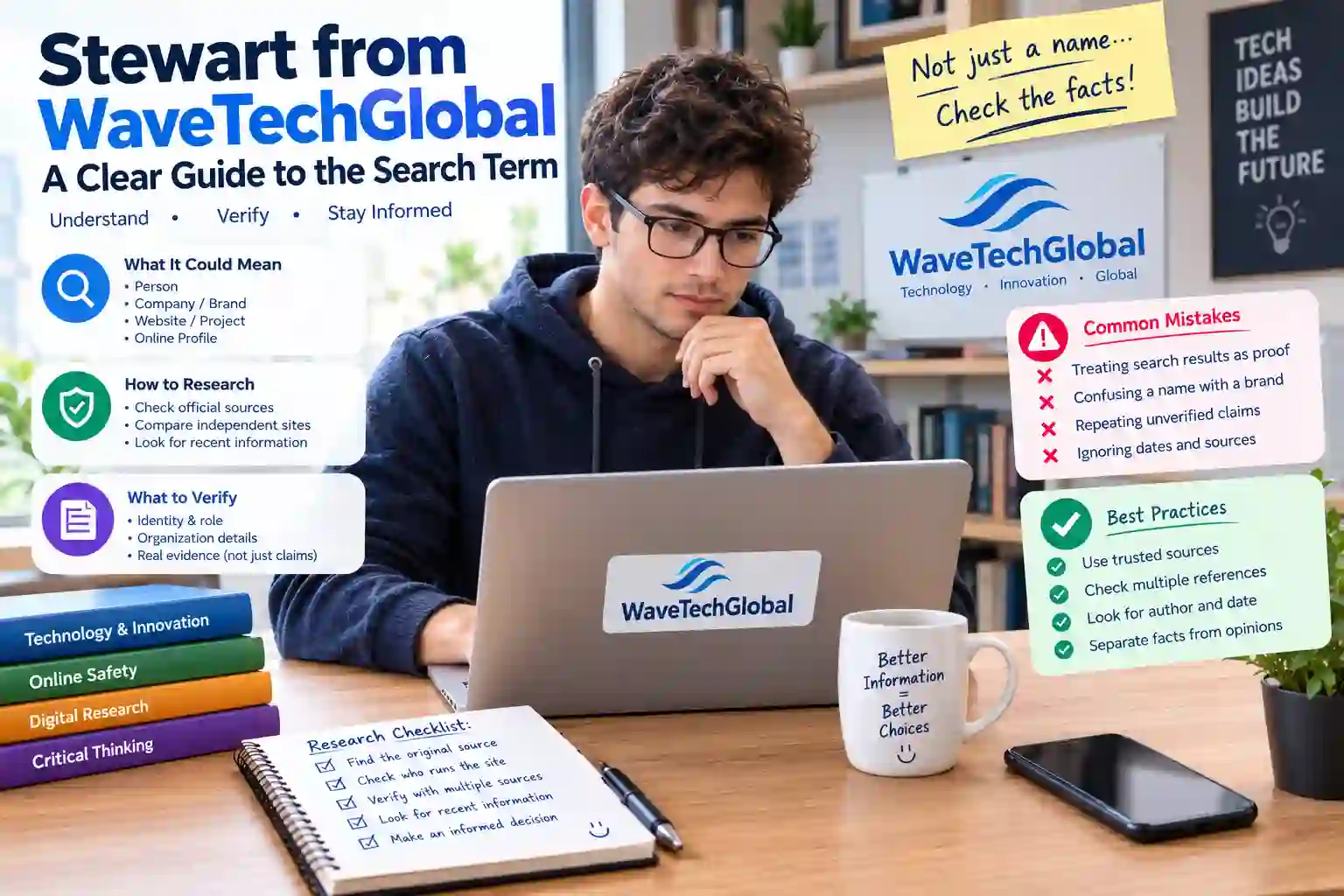
Stewart from WaveTechGlobal is a search phrase that may lead readers toward several questions. People may want to know who Stewart is, what WaveTechGlobal refers to, or how the two names connect. However, a search phrase alone does not prove a person’s identity, job, company role, or professional background. Therefore, careful source checking remains important before accepting claims as facts.
The internet contains many pages with incomplete names, copied descriptions, and unclear profiles. Consequently, readers can easily connect the wrong person with the wrong organization. A similar problem can happen when a technology name appears beside a person’s first name. Without reliable supporting information, assumptions can quickly become presented as established facts.
What the Name WaveTechGlobal May Represent
Understanding the Name Without Guessing
WaveTechGlobal sounds like a technology-related name, but the wording alone cannot establish what it represents. It could refer to a website, project, online profile, business name, community, or another digital identity. However, none of those possibilities should be treated as confirmed without a reliable source. Readers should therefore separate the name itself from claims about its purpose.
Why Context Matters
Search engines often connect words from different pages when showing results. As a result, a person’s name can appear beside an organization name without proving a direct relationship. Search results may also contain old pages or user-generated content. This matters when researching technology terms, especially when comparing them with broader topics such as generative AI models. Therefore, the surrounding context deserves attention before readers draw conclusions about Stewart from WaveTechGlobal.
Search Results Are Not Always Proof
A search result can help users discover information, but it does not automatically verify that information. Google explains that search systems organize publicly available information from many sources. Readers can learn more about how Google Search works through its official Search documentation. This distinction becomes especially useful when a search involves an unfamiliar person or organization.
Who Could Stewart from WaveTechGlobal Be?
The First Name Alone Is Not Enough
Stewart is a common first name, so it cannot uniquely identify one person. Several professionals, creators, developers, writers, and business owners may share the same name. Therefore, a reliable identification normally needs additional details. Those details might include a full name, official profile, company page, location, professional history, or another strong identifying signal.
A Full Name Can Reduce Confusion
A full name usually provides a stronger starting point for research. However, even a full name may match multiple people online. Researchers should compare several details before deciding that two references describe the same individual. For example, matching professional history and official profiles can provide stronger evidence than a name appearing on unrelated websites.
The WaveTechGlobal Connection Needs Evidence
The phrase Stewart from WaveTechGlobal suggests a connection between Stewart and WaveTechGlobal. Yet, the phrase itself does not explain the nature of that connection. It does not establish whether Stewart works there, founded it, writes for it, appears on its platform, or is simply mentioned alongside the name. That relationship should remain unconfirmed until a trustworthy source clearly explains it.
How to Research Stewart from WaveTechGlobal
Start With an Official Source
The strongest starting point is an official source connected to the person or organization. An official website may provide an about page, team profile, author page, company announcement, or contact information. Such pages can offer useful context because they are published by the relevant organization or individual. Still, researchers should check publication dates and page ownership.
Compare Independent Sources
Independent sources can help confirm information found on an official page. For example, professional directories, established publications, conference pages, or recognized industry databases may provide additional evidence. However, those sources should also be examined carefully. Multiple websites repeating identical wording do not necessarily represent multiple independent confirmations.
Check Dates and Page History
Online information can become outdated quickly. A profile may describe a person’s previous position rather than their current role. Similarly, an organization may have changed its name, website, leadership, or business model. Therefore, dates matter when researching Stewart from WaveTechGlobal. Recent evidence should receive attention when the question concerns a current relationship.
What Readers Should Verify
Identity and Professional Role
Readers should first establish whether a source identifies Stewart with enough detail. A useful source should provide more than a first name. It may include a surname, professional title, organization, biography, or verified profile. These details can reduce the risk of confusing one Stewart with another person who has a similar online presence.
Organization Details
WaveTechGlobal also requires separate verification. Researchers should determine whether the name belongs to an active website, company, publication, project, or another type of entity. The name itself cannot establish legal status or business activity. A trustworthy source should explain the organization’s purpose and provide enough information for independent verification.
Claims About Experience
Professional experience should come from a source that can reasonably support the claim. For example, an official company biography may describe someone’s role. A conference organizer may list a speaker’s professional background. A recognized publication may provide an author profile. By contrast, an anonymous post may offer useful clues but should not serve as the only evidence.
Common Mistakes When Researching the Term
Treating Repeated Claims as Confirmed
One common mistake involves assuming that repeated information must be accurate. However, many websites can copy the same original statement. That creates the appearance of multiple sources without providing independent confirmation. Researchers should therefore look for different sources with separate origins. This approach gives a clearer picture of which details are actually supported.
Filling Gaps With Assumptions
Another mistake involves filling missing information with reasonable-sounding details. For example, a technology-related name may encourage assumptions about someone’s profession. Those assumptions can then become part of later articles. The safer approach keeps unknown information clearly separate from verified facts.
Confusing Search Intent With Biography
A search query does not always represent a request for a complete biography. Someone searching Stewart from WaveTechGlobal may simply want to understand a name encountered online. Another person may be looking for an article, profile, or company connection. Understanding the search intent helps researchers provide useful information without creating unsupported personal details.
What a Reliable Profile Should Contain
Basic Identification
A reliable profile should provide enough information to distinguish the subject from other people. A full name is usually helpful, while an official role can add more context. Professional history may also help establish identity. However, sensitive personal information should not be included simply because it appears somewhere online.
Professional Context
A useful profile should explain why the person is connected to the organization or topic. The explanation should come from a credible source rather than an assumption. For example, an official team page may identify an employee. An article by the person may establish authorship. A public professional profile may provide additional context.
Source Transparency
Strong online research makes it clear where important information came from. Readers should be able to follow a claim back to its source. This practice improves trust and makes later corrections easier. Google also provides guidance for creators about producing helpful and reliable content through its Search Central documentation.
Why Source Quality Matters for Technology Topics
Technology Names Can Be Ambiguous
Technology terms often change meaning across websites. A name may describe a brand, software project, media platform, online community, or informal phrase. Therefore, technology research requires attention to context. Readers should avoid treating a brand-like name as a confirmed company until reliable evidence supports that interpretation.
People and Brands Can Share Names
A person’s name may also appear within a brand name or website title. This overlap can make search results harder to interpret. Furthermore, websites sometimes mention people without explaining their relationship to a project. Researchers should therefore examine the original page rather than relying only on search-result snippets.
Current Information Requires Fresh Checking
Online profiles can change over time. A person may move between companies, update a professional profile, or stop working with a particular project. Similarly, websites can disappear or change ownership. Consequently, current claims require recent supporting evidence rather than old references alone.
A Practical Verification Process
Step One: Identify the Exact Subject
The first step is identifying what the searcher actually wants to know. The query may concern a person, organization, article, profile, or technology project. Researchers should then collect the exact names and spellings shown by reliable sources. This prevents early assumptions from shaping the rest of the research.
Step Two: Find the Primary Reference
The next step involves locating the strongest available source. A primary reference could include an official website, verified professional profile, company announcement, or direct publication. Researchers should record the page title and publication date when available. This information helps establish context for later comparisons.
Step Three: Cross-Check Important Details
Important details should then be compared against independent sources. Researchers can check names, roles, dates, organization descriptions, and professional claims. If sources disagree, the disagreement should remain visible. It is better to report uncertainty than to present one unsupported version as certain.
Step Four: Separate Facts From Unknowns
Finally, researchers should divide information into confirmed details and unresolved questions. This simple step improves accuracy. It also prevents speculation from becoming part of a published biography. For Stewart from WaveTechGlobal, this distinction is particularly useful when public information does not clearly establish the person’s identity or role.
What Cannot Be Safely Assumed
No Automatic Job Title
The search phrase does not establish a specific job title for Stewart. It would be unsafe to describe the person as an executive, founder, developer, journalist, consultant, or employee without supporting evidence. A reliable article should only use such titles when an appropriate source clearly provides them.
No Automatic Company Ownership
The phrase also does not establish ownership of WaveTechGlobal. A person can be mentioned by an organization without owning it. Likewise, a person can contribute to a project without founding it. Therefore, ownership claims require direct evidence from credible organizational or legal sources.
No Automatic Personal Biography
A first name and organization name do not provide enough information for a complete personal biography. Details such as age, birthplace, education, family, residence, or career history should never be invented. If reliable public evidence does not establish those details, they should simply remain unknown.
How Readers Can Evaluate Future Results
Look Beyond the First Result
The first search result may be useful, but it should not automatically become the final source. Readers can examine several relevant results and identify where each claim originated. This approach can expose copied information or outdated references. It also helps separate authoritative pages from low-quality content.
Examine the Original Page
Search snippets often shorten or remove important context. Therefore, readers should open the original page when a claim matters. The full page may explain dates, authorship, organizational relationships, and limitations. Researchers should also check whether the page provides contact details or links to other authoritative sources.
Watch for Unsupported Specifics
Very specific claims deserve extra attention when sources are unclear. Exact dates, job titles, company roles, awards, credentials, and professional achievements should have evidence. If a page provides impressive details without credible references, readers should treat them cautiously. Specificity does not automatically make information trustworthy.
Stewart from WaveTechGlobal and Responsible Online Research
Accuracy Is More Useful Than Guesswork
When information remains limited, a careful explanation can still satisfy readers. A responsible article can explain what the search phrase suggests, what remains uncertain, and how readers can verify the details. This approach provides value without creating a fictional profile. It also protects readers from repeating unsupported claims.
Uncertainty Can Be Part of the Answer
Not every online search produces a complete answer. Sometimes the most accurate result is that the available information does not establish a particular detail. That is not a weakness in research. Instead, clearly identifying uncertainty shows that the researcher has separated evidence from assumption.
Search Intent Can Guide Further Research
The next research step depends on what the searcher wants. Someone looking for a professional profile may need an official biography. Someone researching a technology brand may need company information. Another reader may simply want to understand where the phrase appeared. Each purpose requires different evidence.
Questions Readers May Have
What is Stewart from WaveTechGlobal?
The phrase appears to connect a person named Stewart with the name WaveTechGlobal. However, the phrase alone does not establish the person’s full identity or exact relationship with WaveTechGlobal. Reliable sources should be checked before presenting a detailed biography.
Is Stewart a person associated with WaveTechGlobal?
The wording suggests an association, but it does not prove what that association involves. Stewart could be mentioned in connection with the name for several reasons. A primary source is needed before a specific relationship can be confirmed.
Is WaveTechGlobal a technology company?
The name sounds technology-related, but the name alone does not establish its legal or business status. Researchers should look for an official website, business information, or other reliable documentation. Without such evidence, the exact nature of WaveTechGlobal should remain open.
Does Stewart own WaveTechGlobal?
There is no basis in the search phrase alone for claiming ownership. Ownership is a specific factual claim that requires appropriate evidence. An official company source or reliable business record would provide stronger support.
Where can readers verify information about Stewart?
Readers should begin with official sources connected to Stewart or WaveTechGlobal. They can then compare those details with independent professional or industry sources. Dates and authorship should also be checked before accepting important claims.
Why can searches for Stewart from WaveTechGlobal be confusing?
The phrase contains a first name and an organization-like name without enough identifying context. Search engines may also display pages with different purposes or publication dates. Therefore, readers should compare the original sources rather than relying on the phrase alone.
Should readers trust every profile mentioning Stewart?
No profile should receive automatic trust simply because it appears in search results. Readers should examine authorship, source quality, dates, and supporting evidence. Independent confirmation becomes especially important when a profile contains detailed professional claims.
What is the safest way to research the term?
The safest approach starts with the strongest available source and then checks important details independently. Researchers should separate confirmed information from assumptions. When evidence remains incomplete, the final explanation should clearly state what is still unknown.
Final Takeaway
Stewart from WaveTechGlobal is a useful search phrase, but it does not provide enough evidence for a complete personal profile. The wording suggests a connection that needs further verification. Therefore, readers should focus on primary sources, independent confirmation, dates, authorship, and clear explanations of relationships.
Reliable online research does not require filling every gap. Instead, it requires knowing which details are supported and which details remain uncertain. Readers researching Stewart from WaveTechGlobal can use that approach to avoid mistaken identities and unsupported claims. Careful verification creates a clearer and more trustworthy understanding of unfamiliar technology-related searches.