Many teams walk into big meetings with thin notes. They skim a website, read one news story, and hope for the best. A solid research dossier for target company work closes that gap. Without one, buyers, partners, and sales teams miss red flags. Costly surprises often follow.
The fix is simple. A dossier gathers facts from trusted sources into one organized file. This guide explains what to include, where to look, and how to build it step by step. It also shows how automation can speed things up without hurting accuracy.
What Is a Research Dossier and Who Needs One?
A dossier is a structured profile of one organization. It brings together leadership, finances, products, customers, rivals, and recent news. Each fact points back to a source. Therefore, readers can check the work and trust the result. The goal is not a long report. The goal is a clear picture that supports a decision.
Different teams use it for different reasons. Investors want proof before a deal. Sales teams want context before a pitch. Founders want to know a partner before signing. In every case, the file turns scattered facts into something usable.
A simple definition
Think of a dossier as a briefing pack. It answers one question: “Who are we dealing with?” It covers what the company does, who runs it, and how it earns money. It also notes risks, such as lawsuits or sudden leadership changes. Good dossiers stay short, clear, and sourced. A reader should finish it in minutes, not hours.
Who uses a company dossier
Many roles rely on this kind of file. The list below shows the most common ones.
- Investors check the health of a business before committing money.
- Sales teams learn a buyer’s needs before the first call.
- Partnership managers test whether a partner is stable.
- Recruiters study an employer before an executive hire.
One public skill guide describes the same uses. It lists deal preparation, executive briefings, due diligence, and competitor profiles as typical cases.
Why a Research Dossier for Target Company Work Matters
Skipping research is risky. A company may look healthy on its website but carry debt or legal trouble. A leader may have a history that never appears in a press release. Besides that, markets move fast. A fact that was true last year may be false today. A dossier catches these gaps early, while changing course is still cheap.
Research also saves time later. Teams that prepare well ask sharper questions in meetings. They spot weak answers faster. As a result, negotiations feel calmer and more confident. Everyone at the table works from the same facts, which reduces arguments and guesswork.
The cost of skipping research
Weak research leads to three common problems. First, teams overpay because they misjudge value. Second, they miss legal or reputation risks. Third, they lose trust when a partner turns out to be a poor fit. Each problem is avoidable. For example, a buyer who checks court records may find a pending lawsuit before signing. That single check can change the whole deal.
The benefits of preparation
Preparation brings speed and confidence. Analysts face a real scale problem today. Deal volume keeps growing while analyst teams stay flat, so coverage quality suffers. A repeatable dossier format helps. It gives every researcher the same checklist. Consequently, quality stays steady even when workloads rise.
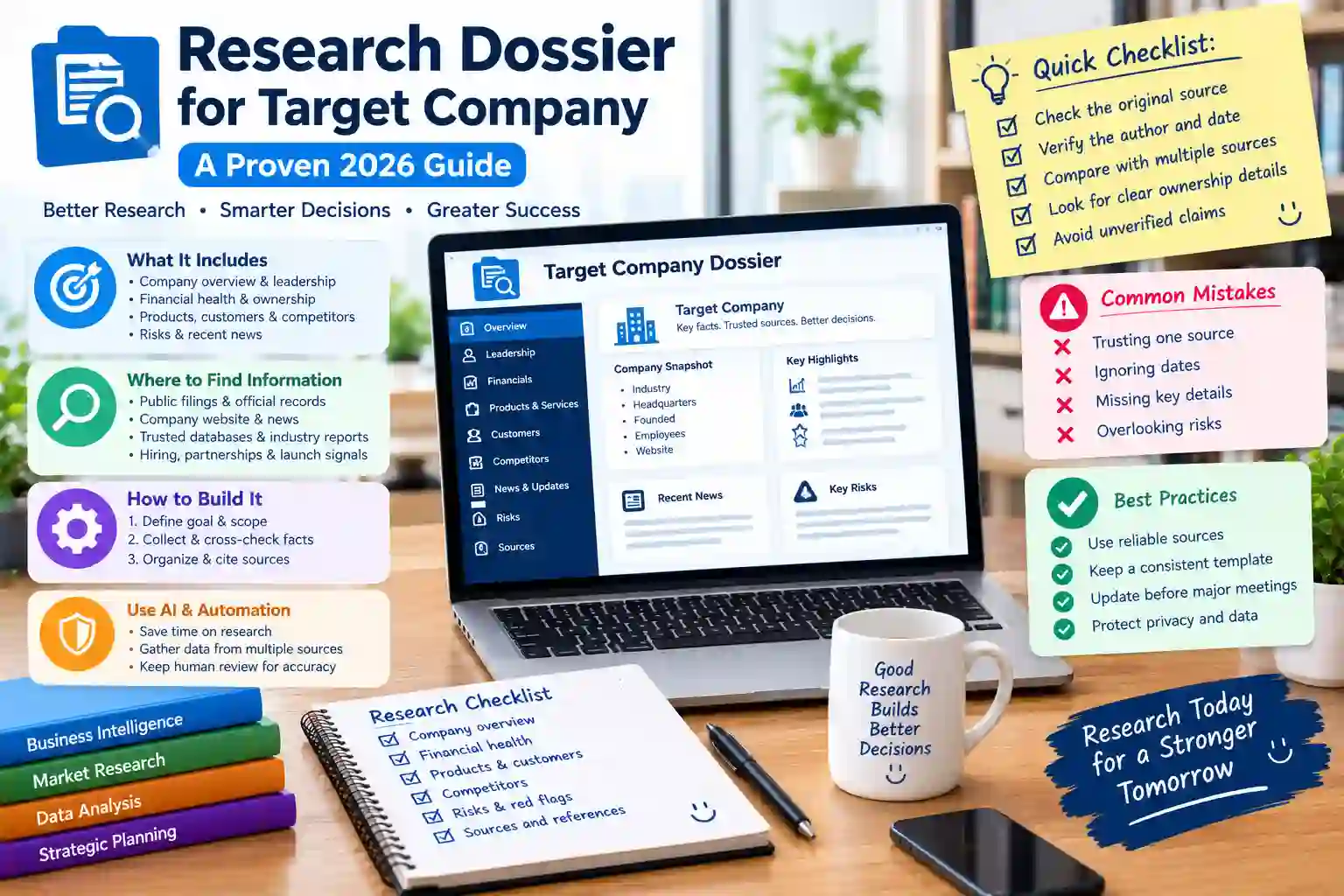
Core Sections Every Company Dossier Should Include
A strong dossier follows a clear layout. Readers should find answers without hunting. Most good files start with a one-page summary. Then they move into details. Each section should stay focused on facts, not opinions. When something is uncertain, the file should say so plainly.
Keep the order consistent across every profile. This makes comparing companies easy. It also helps new team members learn the format fast. A research dossier for target company projects works best when the template never changes from one file to the next.
Company overview and leadership
Start with the basics. Note the legal name, founding year, headquarters, and size. Then list the key executives and board members. Add short notes on their past roles. Leadership matters because people shape strategy. A recent change at the top can signal a new direction. It can also signal trouble, so note the dates carefully.
Financial health and ownership
Next, look at the numbers. Record revenue, profit trends, funding rounds, and major investors. Note who owns the company and whether it has parent firms. Public companies share detailed reports, while private ones share less. In that case, use funding news and other signals. Always mark which figures are confirmed and which are estimates.
Products, customers, and competitors
Finally, describe what the company sells and to whom. List its main products, key customers, and partners. Then name the top rivals and explain how the company differs. Automated dossier workflows gather the same items: executives, customers, product lines, partnerships, and competitive position. This section shows where the company stands in its market.
Where to Find Reliable Information
Good dossiers depend on good sources. Start with primary sources, which come straight from the company or a regulator. Then add trusted third-party reporting. Avoid anonymous forums unless the topic demands them. Even then, treat those posts as leads, not proof.
Variety also matters. A single source can be wrong or biased. Several sources that agree give much stronger proof. So researchers should always look at more than one place before writing a claim into the file.
Public filings and official records
Official records are the strongest evidence. Public companies in the United States file reports with the SEC’s EDGAR. Court records show lawsuits, and patent offices show intellectual property. One industry guide names SEC EDGAR, Crunchbase, PACER, and USPTO as core data sources for this work. Each one answers a different question about the target.
The company website and news coverage
The company’s own site shows how it wants to be seen. Read the about, team, and pricing pages. Then compare those claims with independent news. One research guide suggests starting with the vendor’s website and then cross-checking material claims across other sources. Differences between the two often reveal the most useful insights.
Traction and momentum signals
Finally, watch for signs of movement. Hiring surges, product launches, and new partnerships all show direction. The same guide lists hiring, launches, and partnerships as useful traction signals. A company that posts many open roles is usually growing. A company with no updates for a year may be slowing down.
A Step-by-Step Process to Build the Dossier
A clear process keeps the work fast and honest. Many researchers fail because they start collecting before they know the goal. Others collect too much and never finish. A simple plan prevents both problems.
The steps below work for small teams and large ones. They also work for one-off projects and repeat research. Moreover, anyone can follow them without special tools. A research dossier for target company review becomes much easier when the steps stay the same each time.
Define the goal and scope
First, write the purpose in one sentence. For example: “Decide whether to partner with this firm.” The purpose decides what to include. A partner check needs stability and reputation data. A sales call needs pain points and buying signals. Next, set a time limit. Without one, research can drift for days with little value.
Collect and cross-check facts
Now gather facts from the sources above. Record each fact with its link and date. Then compare claims across sources. If two sources disagree, note both and investigate further. Never average conflicting numbers. One practical tip from a browser research guide is to attach the source URL to every fact so others can verify it.
Organize and cite
Last, arrange the facts into your template. Keep the summary on top. Use the checklist below before sharing the file.
- Every fact has a source and a date.
- Conflicting data is flagged, not hidden.
- Risks are listed in their own section.
- The summary fits on one page.
Using AI and Automation Without Losing Accuracy
Modern tools, especially generative AI models, can do much of the heavy lifting. They search many sources at once and pull out key details. As a result, work that once took weeks can shrink to hours. One industry guide says a well-built pipeline can cut deal-level research from weeks to hours while covering more sources. That is a real gain for busy teams.
Still, speed is not the same as truth. Automated tools can miss context or repeat errors. So teams need clear rules. A good research dossier for target company processes blends machine speed with human judgment. Each side covers the other’s weak spots.
Where automation helps most
Automation shines at repetitive tasks. It can scan filings, track news, and list changes each quarter. It can also build the first draft of a profile. For instance, one tool prompt asks for what changed at a company in the last quarter, with each finding linked to its page. That kind of tracking saves hours of manual checking.
Where humans must stay involved
People must still judge what matters. A human reviewer should verify key numbers, check odd claims, and read between the lines. They should also decide how much risk is acceptable. Tools can gather facts, but they cannot own the decision. Therefore, every final dossier should carry a named reviewer and a review date.
Common Mistakes and Best Practices
Even skilled teams repeat a few avoidable errors. Most come from rushing or from trusting one source too much. Learning these traps early saves time and protects credibility. The fixes are simple and cost almost nothing.
Good habits also compound over time. A team that keeps clean, dated files builds a useful library. Later, it can compare companies quickly and spot patterns. Small discipline today creates a big advantage tomorrow.
Mistakes to avoid
Four mistakes appear again and again. Researchers copy marketing claims without checking them. They forget to record dates, so old facts look new. They bury risks deep in the file. Finally, they build dossiers without a clear goal. Avoiding these errors alone puts a file ahead of most others.
Best practices to follow
Keep the format consistent and the language plain. Update the file before any major meeting, because facts age fast. Store sources in one shared place. Finally, protect privacy. Use only public or properly approved information, and follow local data laws. Ethical research builds trust with clients and partners.
Frequently Asked Questions
What is a research dossier for a target company?
It is a sourced profile of one organization. It covers leadership, finances, products, customers, rivals, and risks. Teams use it to prepare for deals, sales calls, or partnerships.
How long should a company dossier be?
Most useful files run between three and ten pages. The summary should fit on one page. Longer files are fine only when the decision is large, such as an acquisition.
What sources are best for company research?
Official records come first, such as regulatory filings and court documents. Next come the company website and trusted news outlets. Finally, add hiring and launch signals. Always confirm important facts in at least two places.
How often should a dossier be updated?
Update it before every major meeting or decision. For active deals, a monthly check is wise. Fast-moving companies may need even more frequent reviews.
Can AI build a company dossier?
Yes, AI tools can gather sources and draft a first version quickly. However, a human should verify key facts. Machines can miss context, so review remains essential.
What is the difference between a dossier and due diligence?
A dossier is a focused profile that supports a decision. Due diligence is a deeper, formal review, often with legal and financial experts. Many teams build a dossier first and then decide whether deeper review is needed.
Is it legal to research a company this way?
Researching public information is generally legal. Problems arise when people use private data or break access rules. Follow local laws and stick to public or approved sources.
What should be included in the summary?
Include what the company does, who leads it, how it earns money, and its top risks. Add one line on why it matters to your goal. Keep it short so busy readers act on it.
Final Thoughts
A well-built dossier turns scattered facts into clear decisions. It shows who leads the company, how it makes money, and where trouble may hide. More importantly, it gives every team member the same trusted picture. Strong sources, a fixed template, and careful checking make the biggest difference. That is why each research dossier for target company files should stay sourced, dated, and reviewed.
Ready to start? Pick one company you plan to meet this month. Follow the steps in this guide and build your first file today. For more practical tech and research guides, keep exploring futuretechguide.it.com.
2 thoughts on “Research Dossier for Target Company: A Proven 2026 Guide”